
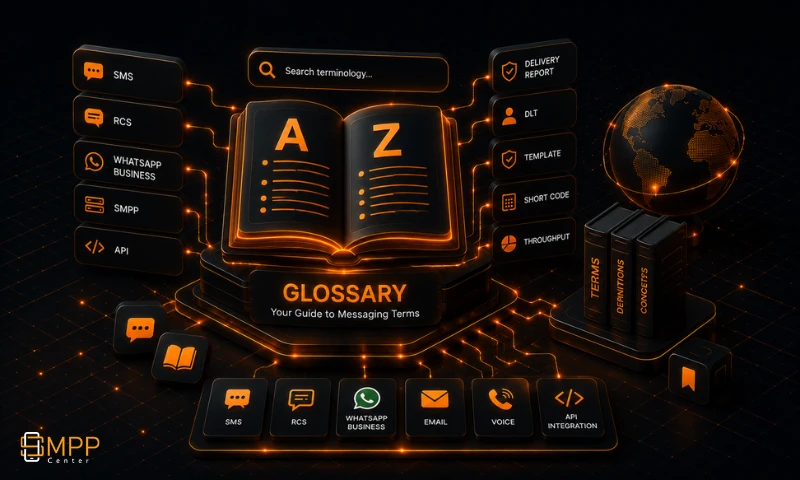
Messaging Glossary: SMS, SMPP, WhatsApp, RCS & API Terms
SMS and SMPP have their own vocabulary, and most of it doesn't explain itself. This page collects the terms that come up constantly across integration docs, compliance requirements, and vendor conversations, defined in plain language. For the deeper protocol-level walkthrough, see What Is SMPP? and SMPP vs HTTP API.
SMPP
Short Message Peer-to-Peer, a binary protocol used to exchange SMS traffic between an application and an SMSC at high throughput, the standard aggregators and enterprises build on instead of a plain HTTP API.
ESME
External Short Messaging Entity, the client-side application that connects to an SMSC over SMPP to send and receive messages. Your billing system, panel, or CRM acts as an ESME when it binds to an SMPP server.
SMSC
Short Message Service Center, the server-side system that receives, stores, forwards, and routes SMS messages between an ESME and the mobile network.
PDU
Protocol Data Unit, the individual binary message exchanged over an SMPP session, such as submit_sm to send a message or deliver_sm to receive one.
submit_sm
The SMPP PDU used by an ESME to submit an SMS for delivery to the SMSC.
deliver_sm
The SMPP PDU used by an SMSC to deliver incoming SMS messages or delivery receipts to an ESME.
TPS
Transactions Per Second, the throughput a connection can sustain. SMPPCenter's own platform runs production traffic up to 10,000 TPS.
DLR
Delivery Receipt, the status update confirming whether a sent message actually reached the handset, was queued, or failed.
OTP
One-Time Password, a short-lived code sent by SMS, WhatsApp, or another channel to verify a user during login, signup, or a sensitive transaction.
DLT
Distributed Ledger Technology registration, India's regulatory framework requiring senders, headers, and message templates to be pre-registered and matched before a commercial SMS is allowed to send.
Webhook
An HTTP callback a platform sends to your system in real time, commonly used to deliver DLRs or inbound message events as POST/GET/JSON/XML.
SMPP Client
The application-side software that binds to an SMSC as an ESME to submit and receive messages.
SMPP Server
The SMSC-facing software that accepts ESME binds and routes traffic to and from the mobile network.
Bind
The authenticated session an ESME opens with an SMSC before it can exchange messages. SMPP defines three bind types: Transmitter (send only), Receiver (receive only), and Transceiver (both).
A2P
Application-to-Person messaging, automated SMS sent from a business system to an individual, covering OTPs, alerts, and marketing, as opposed to person-to-person texting.
HTTP API
A REST-style interface for sending SMS over standard web requests instead of a persistent SMPP bind, generally simpler to integrate but with different throughput and reliability trade-offs.
SMS Gateway
The overall system, whether SMPP-based, HTTP API-based, or hardware, that sits between an application and the mobile network to send and receive SMS.
Aggregator
A business that connects directly to mobile operators and resells SMS delivery capacity to downstream clients or resellers.
Reseller
A business that buys or licenses SMS gateway capacity and resells it to its own downstream clients, typically through a multi-tier Admin/Reseller/User panel structure.
RCS
Rich Communication Services, a richer messaging standard than SMS supporting media, buttons, and read receipts within the native messaging app.
Sender ID
The alphanumeric or numeric identifier a recipient sees as the message sender, such as a brand name for promotional SMS or a shared/dynamic ID for transactional traffic.
NCPR / DND
National Customer Preference Register, the India-specific do-not-disturb list that promotional SMS must be scrubbed against before sending, to avoid contacting opted-out numbers.
Two-Way SMS
SMS messaging that supports inbound replies from the recipient being routed back to the sending application, not just outbound delivery.
Transceiver
An SMPP bind mode that allows sending and receiving messages over a single connection, making it the preferred option for most modern SMS gateway deployments.
Unicode SMS
SMS encoded using Unicode, allowing non-Latin languages such as Hindi, Arabic, Chinese, Japanese, and emojis, with a lower character limit than GSM encoding.
Short Code
A shortened mobile number, typically 4 to 6 digits, used for high-volume business messaging, campaigns, and customer interactions.
Long Code
A standard mobile phone number used for two-way messaging, OTPs, or conversational communication.
WhatsApp Template
A pre-approved message template required for initiating business conversations outside the customer service window on WhatsApp.
REST API
A web service interface that uses standard HTTP methods such as GET and POST for application integration.
AI Agent
An AI-powered software assistant capable of understanding user requests, performing actions, integrating with APIs, and automating customer conversations.
LLM
Large Language Model, an artificial intelligence model trained on massive text datasets to understand and generate human language.
DPDP Act
India's Digital Personal Data Protection Act governing how organizations collect, process, store, and protect personal data.
GDPR
The European Union General Data Protection Regulation governing the collection, processing, and protection of personal data.
BSP
Business Solution Provider, a company authorized by WhatsApp to provide access to the WhatsApp Business API on behalf of businesses.
Transmitter
An SMPP bind mode that only allows outbound message submission from the ESME to the SMSC.
Receiver
An SMPP bind mode that only receives inbound messages and delivery receipts from the SMSC.
enquire_link
An SMPP keep-alive command exchanged periodically between an ESME and SMSC to verify that the connection is still active.
Long SMS
An SMS message exceeding 160 GSM characters or 70 Unicode characters that is automatically split into multiple segments and reassembled on the recipient device.
Concatenated SMS
A multipart SMS consisting of multiple message segments combined into a single readable message on the recipient handset.
GSM 7-bit
The default SMS character encoding supporting most Latin characters with a maximum of 160 characters per message.
MO SMS
Mobile Originated SMS, a message sent by the mobile subscriber to a business application.
MT SMS
Mobile Terminated SMS, a message sent from a business application to a mobile subscriber.
Virtual Number
A cloud-based phone number that forwards calls or messages to another destination without requiring a physical SIM card.
Flash SMS
A Class 0 SMS displayed immediately on the recipient screen without being stored in the inbox unless manually saved.
Delivery Rate
The percentage of submitted messages successfully delivered to recipient devices.
Queue
Temporary storage where outgoing messages wait before being processed and delivered to downstream operator connections.
Rate Limiting
A mechanism that restricts the number of API requests or messages processed within a specified time to prevent overload or abuse.
Load Balancer
Infrastructure that distributes messaging traffic across multiple servers to improve scalability, redundancy, and availability.
Failover
Automatic switching to a backup server or route when the primary messaging system becomes unavailable.
High Availability (HA)
A system architecture designed to minimize downtime through redundancy, clustering, and automatic failover.
Private Cloud
A dedicated cloud deployment where messaging infrastructure runs exclusively for one organization, providing greater control over security, compliance, and data residency.
Data Residency
The requirement that customer data remains stored and processed within a specific geographic region or country to meet regulatory obligations.
WhatsApp Business API
The enterprise messaging platform provided by Meta that enables businesses to automate conversations, notifications, authentication, and customer support at scale.
Conversation Window
The 24-hour period after a customer sends a WhatsApp message during which businesses can freely exchange messages without template restrictions.
Embedded Signup
Meta's onboarding process allowing businesses to connect their WhatsApp Business Account directly from a Business Solution Provider portal.
Meta Business Account
A Meta account used to manage WhatsApp Business Accounts, Facebook Pages, Instagram assets, and advertising resources.
Blue Tick
WhatsApp Official Business Account verification indicating a notable and authenticated business presence.
Quality Rating
Meta's measurement of customer feedback and messaging quality that affects WhatsApp messaging limits and account health.
RCS Business Messaging
The enterprise implementation of Rich Communication Services that supports branded conversations, rich media, suggested replies, and verified sender identities.
Verified Sender
A messaging identity verified by the platform to improve customer trust and reduce phishing risks.
Rich Card
An RCS message component containing images, text, buttons, or actions displayed within a conversation.
Carousel
An RCS feature allowing multiple interactive cards to be presented in a horizontally scrollable format.
API Key
A unique credential used to authenticate API requests and authorize access to messaging services.
OAuth
An industry-standard authorization framework allowing applications to securely access APIs without sharing user passwords.
JSON
JavaScript Object Notation, the lightweight data format most commonly used for messaging APIs and webhook payloads.
Prompt Engineering
The practice of designing instructions that improve the quality, consistency, and accuracy of responses generated by AI models.
Vector Database
A specialized database used by AI applications to store and retrieve semantic embeddings for knowledge retrieval.
Retrieval-Augmented Generation (RAG)
An AI architecture that combines information retrieval with large language models to generate responses grounded in external knowledge.
Consent Management
Processes used to capture, store, update, and audit customer permission before sending marketing or transactional communications.
Message Queue
A buffering mechanism that stores messages before delivery, improving reliability, scalability, and fault tolerance during traffic spikes.
Horizontal Scaling
Increasing system capacity by adding additional messaging servers rather than upgrading a single server.
Disaster Recovery (DR)
Policies and infrastructure designed to restore messaging services after hardware failures, outages, or disasters.
Don't see the term you're looking for?
Tell us what you're trying to build, and we will walk you through it directly.
Talk to a SpecialistClient Feedback
What Our Clients Say
Our clients run regulated, high-volume messaging infrastructure and prefer not to be named publicly. These testimonials are shared with permission while keeping commercially sensitive details confidential.
The migration was completed smoothly and the platform has remained stable under heavy production traffic. The flexibility of self-hosting was one of the biggest advantages for us.
High throughput, intelligent routing, and detailed monitoring have significantly simplified our messaging operations.
We needed complete control over our messaging infrastructure instead of relying on a hosted provider. The platform has delivered excellent performance and reliability.
The delivery reports and routing controls give us the visibility we were looking for. The system has integrated well with our internal applications.
Names and company details are withheld at our clients' request. This is common among telecom providers, SMS aggregators, fintech companies, and enterprises that consider their messaging infrastructure commercially sensitive.