
SMPP vs HTTP API
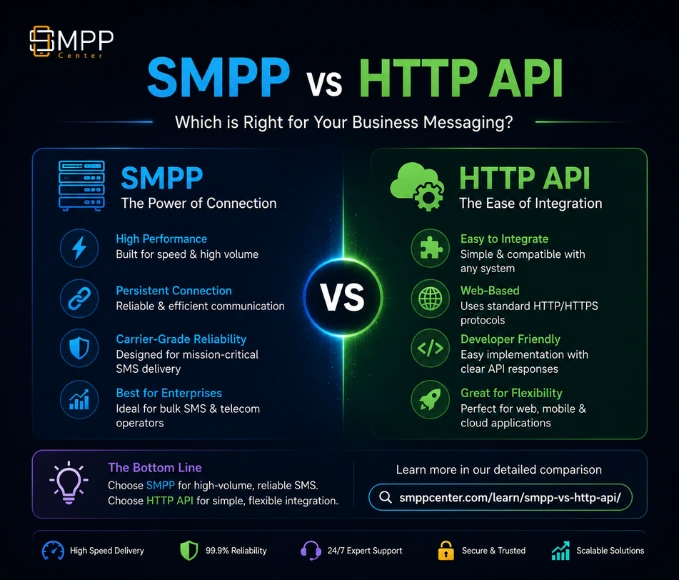
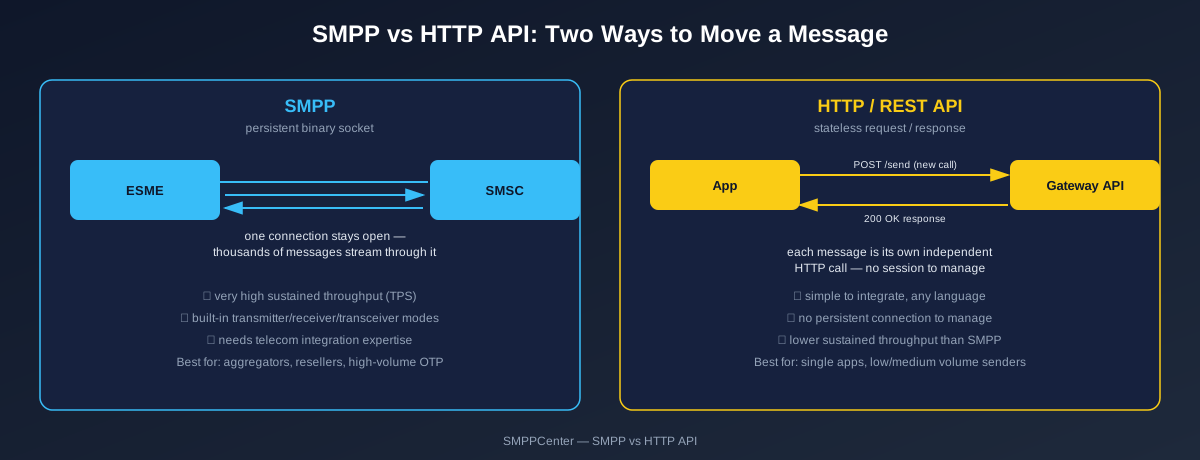
If you already know what SMPP is, the next question is usually practical: should you actually use it, or is an HTTP/REST SMS API the better fit? Both protocols move the same thing - an SMS message from an application to a handset — but they get there in structurally different ways, and that difference has real consequences for throughput, integration effort, and cost.
The Core Architectural Difference
Side-by-Side Comparison
| Dimension | SMPP | HTTP / REST API |
|---|---|---|
| Connection model | Persistent binary socket, bound once and reused | Stateless — a new request for every message |
| Sustained throughput | Very high; built for thousands of messages per second on one connection | Lower ceiling; each call carries its own connection overhead |
| Integration effort | Requires telecom-specific SMPP library/session handling | Works with any language's basic HTTP client — minutes to integrate |
| Delivery receipts (DLR) | Defined in the protocol itself (deliver_sm); generally consistent | Usually via webhook; quality and speed vary by provider |
| Operational overhead | You manage session binds, keepalives, and reconnects | None — no session state to maintain between calls |
| Typical users | Aggregators, resellers, high-volume OTP/transactional senders | Single applications, low-to-medium volume senders |
Not sure which protocol fits your sending volume?
Talk to an SMPP Software Specialist — we'll size it to your actual peak load.
Talk to a SpecialistWhich One Should You Actually Use?
Choose HTTP API If
You are adding SMS to a single application, sending a moderate volume, and want to be integrated in minutes without managing a persistent connection.
Choose SMPP If
You are sending high volumes of transactional or OTP traffic where throughput and reliability cannot be compromised, or you are, or want to become, an SMS reseller or aggregator — running both an SMPP client and an SMPP server. See the full breakdown in the SMS Gateway Software guide, and the reseller side on SMPP Provider.
It Doesn't Have to Be One or the Other
Many growing businesses start on an HTTP API while integration speed matters most, and move to SMPP once volume and throughput requirements outgrow what a stateless API can sustain. SMS gateway software that supports both protocols — like SMPPCenter — lets you make that shift without re-architecting your integration from scratch.
FAQ
Frequently Asked Questions
See SMPPCenter's SMS Gateway Features in Detail
Explore FeaturesClient Feedback
What Our Clients Say
Our clients run regulated, high-volume messaging infrastructure and prefer not to be named publicly. These testimonials are shared with permission while keeping commercially sensitive details confidential.
Excellent documentation, responsive technical support, and an enterprise-grade platform that scales as our business grows.
API integration was straightforward and the support team assisted us throughout deployment. We now manage multiple operator connections from a single platform.
We evaluated several messaging platforms before selecting SMPP Center. The deployment flexibility and API capabilities matched our enterprise requirements.
The migration was completed smoothly and the platform has remained stable under heavy production traffic. The flexibility of self-hosting was one of the biggest advantages for us.
Names and company details are withheld at our clients' request. This is common among telecom providers, SMS aggregators, fintech companies, and enterprises that consider their messaging infrastructure commercially sensitive.