
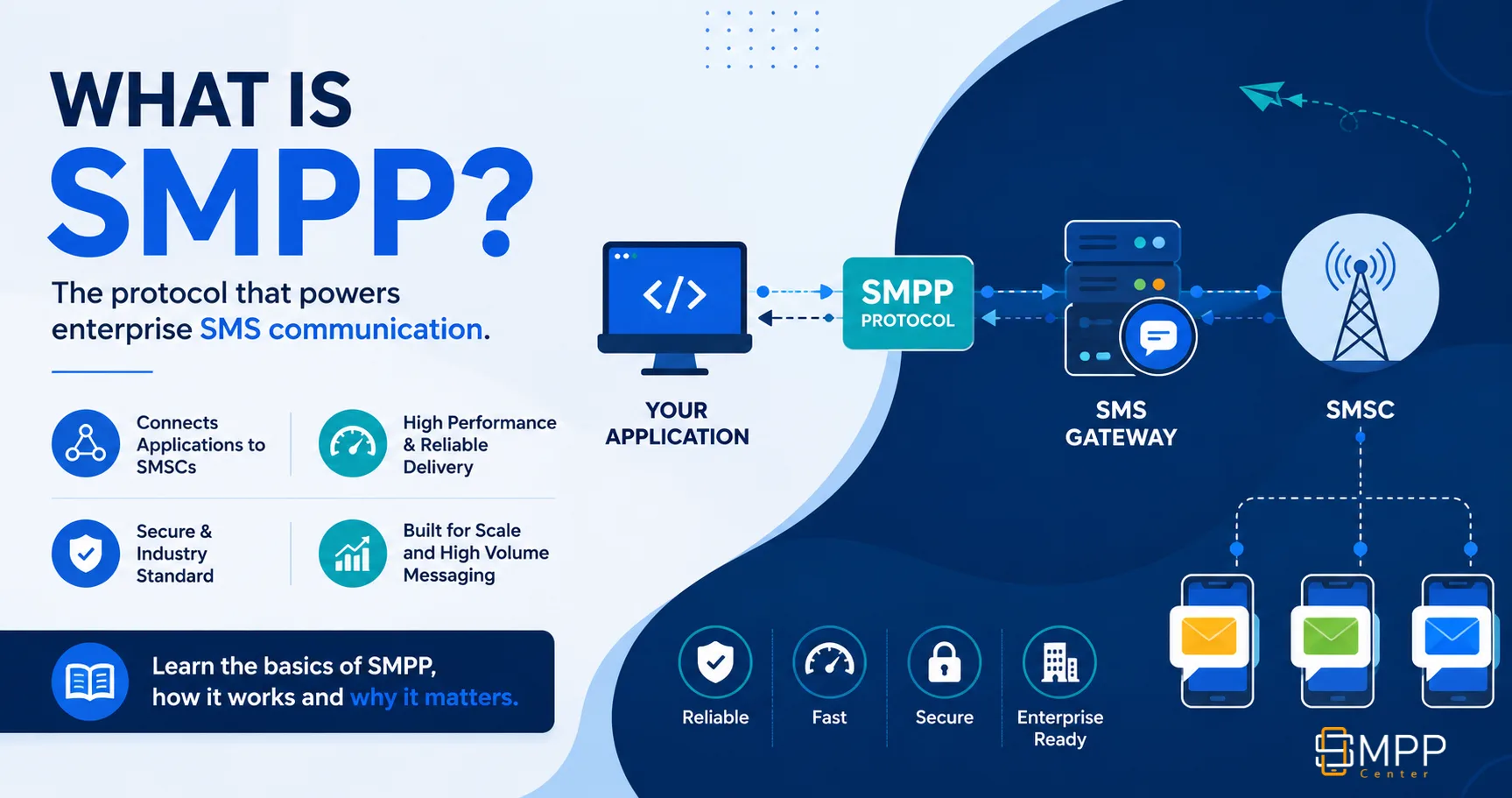
SMPP stands for Short Message Peer-to-Peer. It is a binary protocol, not a piece of software — a defined set of rules for how two systems exchange SMS messages over a single, persistent TCP/IP connection. If you have read about SMS gateway software and seen "SMPP" mentioned as the protocol behind high-volume messaging, this page is the deep dive on what that actually means and how it works under the hood.
SMPP matters because it is the reason aggregators, resellers, and enterprises sending large volumes of OTP or transactional SMS can sustain thousands of messages per second without their infrastructure falling over. Understanding it — even at a conceptual level — makes every other decision about SMS gateway software easier.
The Two Sides of an SMPP Connection
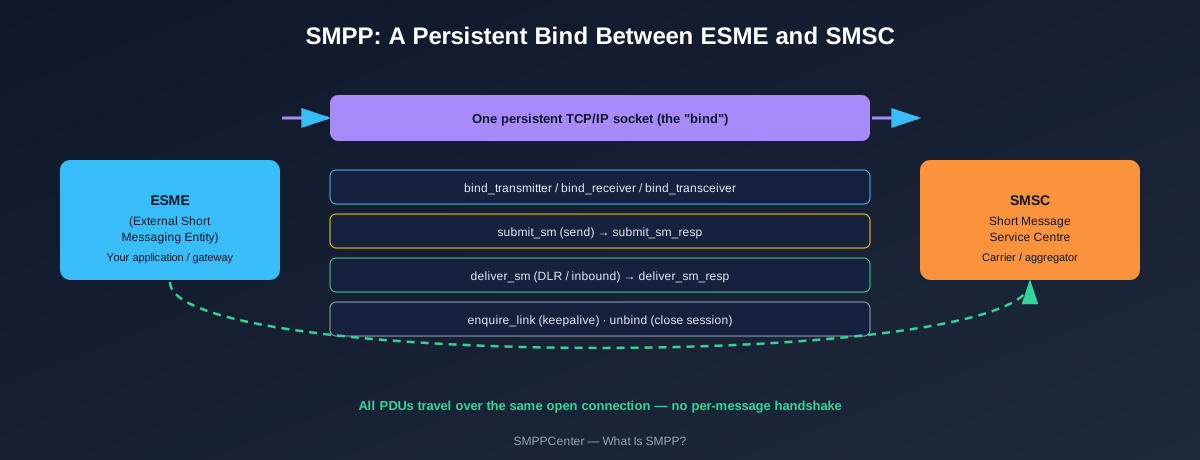
Every SMPP conversation happens between two named roles. An ESME connects to an SMSC over a plain TCP/IP socket and keeps that connection open for as long as it needs to send or receive traffic — this is the single biggest architectural difference between SMPP and an HTTP-based SMS API, where every message is its own independent, short-lived request.
The Bind: How an ESME Authenticates to an SMSC
Before any message can move, the ESME sends a "bind" request to authenticate and open the session. SMPP defines three bind types, and which one you use depends on what the session needs to do.
bind_transmitter
A send-only session. The ESME can submit messages but cannot receive inbound messages or delivery receipts on this connection.
bind_receiver
A receive-only session. The ESME receives inbound messages and delivery receipts but cannot send.
bind_transceiver
Both directions on a single session. The most common choice for modern integrations — no need to manage two separate connections.
PDUs: The Messages That Move Over an SMPP Session
Once bound, an ESME and SMSC exchange PDUs (Protocol Data Units) — structured, binary-encoded messages that each represent one specific action. The ones you will encounter most often:
| PDU | Direction | What it does |
|---|---|---|
| submit_sm | ESME → SMSC | Submits an outbound SMS message for delivery. The SMSC replies with submit_sm_resp, acknowledging receipt and returning a message ID. |
| deliver_sm | SMSC → ESME | Delivers an inbound SMS to the ESME, or delivers a delivery receipt (DLR) reporting the final status of a previously submitted message. |
| enquire_link | Either direction | A lightweight keepalive/heartbeat PDU that confirms the connection is still alive during periods of low traffic. |
| unbind | Either direction | Gracefully closes the session before the underlying TCP connection is dropped. |
Because all of these PDUs travel over the same already-open connection, there is no per-message handshake or connection setup overhead — which is exactly why a single SMPP session can sustain far higher throughput than making a fresh HTTP request for every message. For the full side-by-side comparison, see SMPP vs HTTP API.
Ready to see SMPP client and server features in one platform?
Talk to an SMPP Software Specialist about your integration.
Talk to a SpecialistWhy SMPP Client and Server Both Matter
Most businesses only ever need an SMPP client — connecting outward to a carrier or aggregator's SMSC to send their own traffic. But if you are, or want to become, an SMS reseller or aggregator, you also need an SMPP server: the ability to accept bind requests from your own downstream clients, the same way an SMSC accepts binds from you. Running both sides is what turns SMS gateway software into an aggregator/reseller platform rather than a simple sending tool. For a full breakdown of each side, see What Is an SMPP Client? and What Is an SMPP Server?, or SMPP Provider and Rent SMPP Application for how SMPPCenter packages both together.
Common SMPP Terms, Explained
Window Size
The number of PDUs an ESME can have outstanding (sent but not yet acknowledged) on a session at once — tuning this affects throughput.
Throttling
A response an SMSC can send (ESME_RTHROTTLED) when an ESME is submitting faster than the SMSC currently allows.
Sequence Number
A unique identifier on every PDU that matches a request to its response, since multiple PDUs can be in flight at once.
DLR
Delivery Receipt, delivered via deliver_sm, confirming a message was delivered, failed, or is pending. See SMPP Center's DLR features.
FAQ
Frequently Asked Questions
See SMPPCenter's SMS Gateway Features in Detail
Explore FeaturesClient Feedback
What Our Clients Say
Our clients run regulated, high-volume messaging infrastructure and prefer not to be named publicly. These testimonials are shared with permission while keeping commercially sensitive details confidential.
The migration was completed smoothly and the platform has remained stable under heavy production traffic. The flexibility of self-hosting was one of the biggest advantages for us.
The platform has been reliable for business-critical messaging. Multi-connection support and detailed logging have made daily operations much easier.
The delivery reports and routing controls give us the visibility we were looking for. The system has integrated well with our internal applications.
Excellent documentation, responsive technical support, and an enterprise-grade platform that scales as our business grows.
Names and company details are withheld at our clients' request. This is common among telecom providers, SMS aggregators, fintech companies, and enterprises that consider their messaging infrastructure commercially sensitive.