
Let AI Hosts Send on the Stack You Already Run
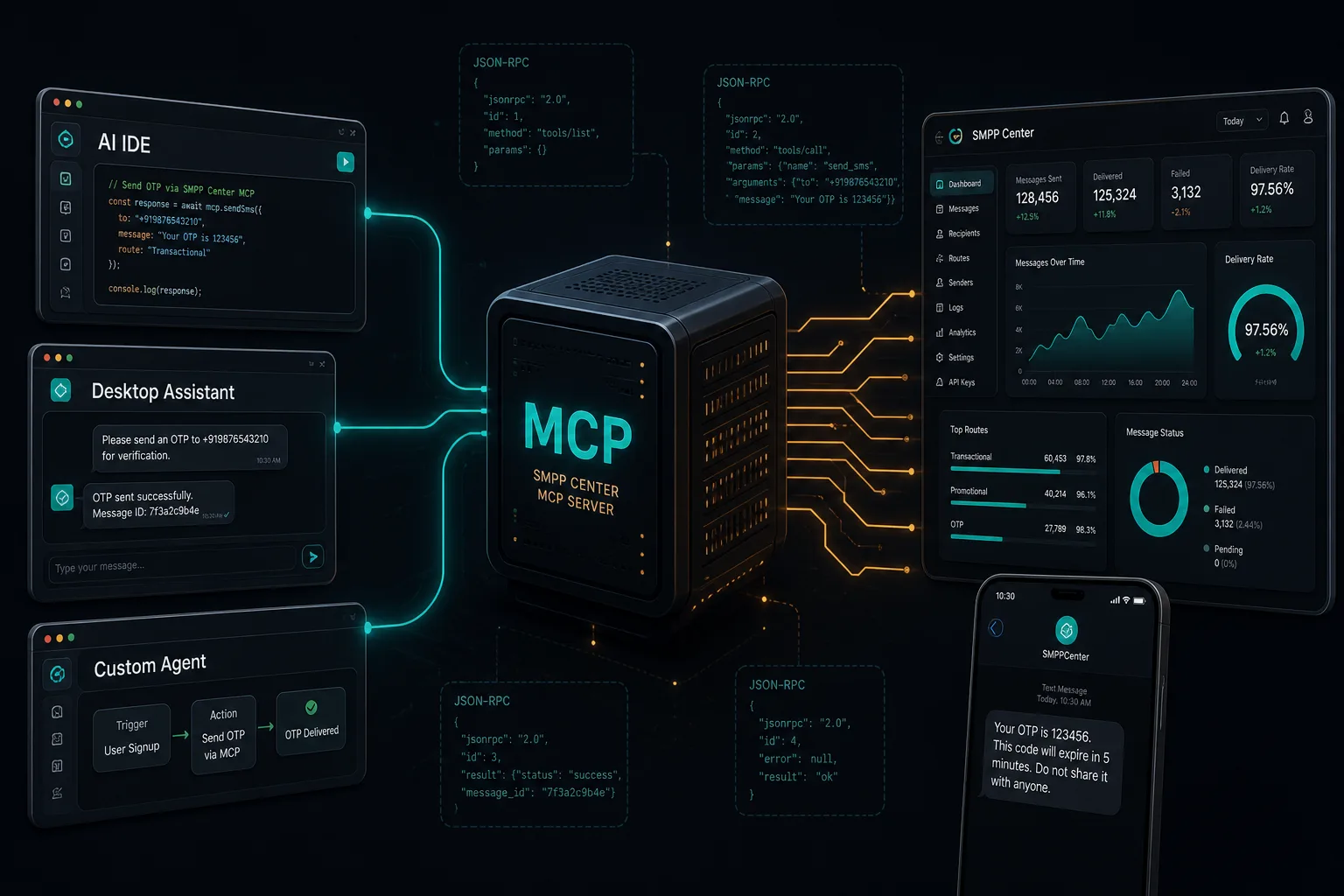
MCP is the open standard that lets an AI host discover tools and call them over JSON-RPC. SMPP Center ships an MCP server on your licensed platform so Cursor, Claude Desktop, ChatGPT connectors, or a custom agent can send SMS, WhatsApp, RCS, or voice without a one-off plugin for each host.
Remote HTTP hosts authenticate with OAuth and PKCE, not a long-lived SMS key in a config file. The token maps to Admin, reseller, or user on your instance. Credits, templates, routing, and IP allowlists stay inside SMPP Center. See SMS and SMPP Software Features for the panels those sends already use.
13 years running production SMS traffic, now reachable from the AI tools your operators already use.
How an MCP Send Works
The host never talks to an SMSC directly. It calls a named tool. Your platform does the rest, then returns the result.
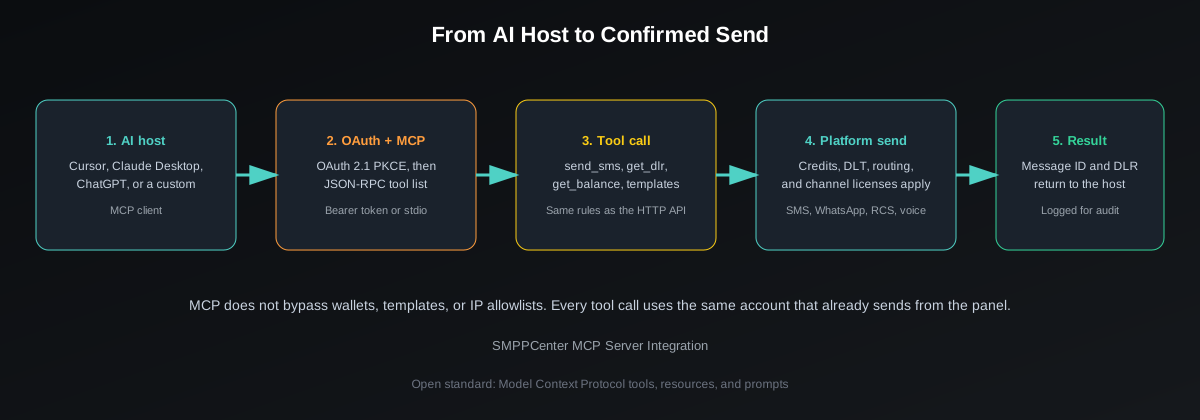
AI host connects
Cursor, Claude Desktop, ChatGPT, or a custom client opens the MCP session you configured.
OAuth handshake
Remote HTTP uses OAuth with PKCE. The bearer token maps to the same Admin, reseller, or user as the panel.
Tool call
The model picks send_sms, get_dlr, get_balance, or a template lookup. Arguments are schema-checked.
Platform send
Credits, DLT, routing, and channel licenses apply exactly as they do from the panel or REST API.
Result back
Message ID, DLR, or balance returns to the host. The tool call is written to the audit log.
OAuth for Remote MCP
A remote MCP server is an OAuth resource server. The host discovers how to sign in, the operator consents, and tool calls carry a short-lived bearer token bound to this MCP URL. That is the Model Context Protocol authorization model, not a custom SMS login.
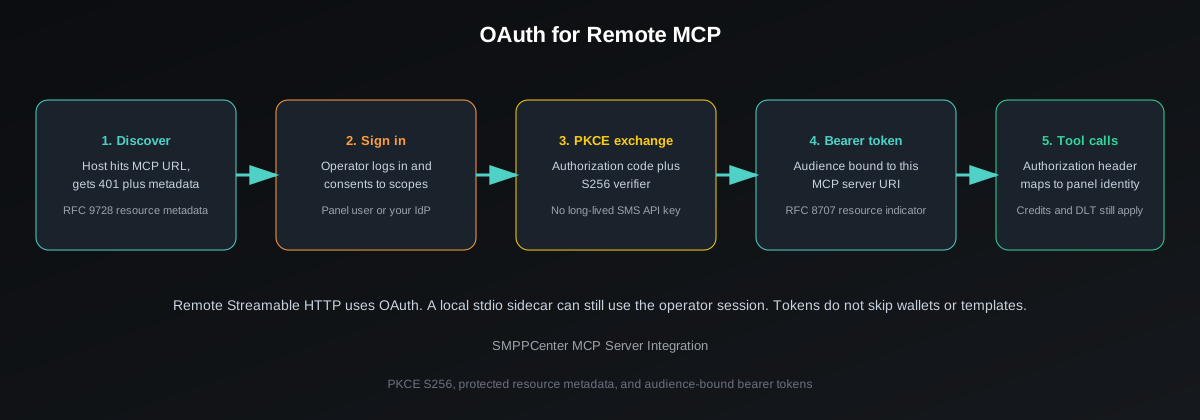
Protected resource metadata
An unauthenticated call returns 401 with a pointer to the authorization server. The host does not guess login URLs.
Login and consent
The operator signs in with panel credentials or your IdP (Okta, Azure AD, Keycloak, Auth0) and approves send or lookup scopes.
PKCE (S256)
Authorization-code exchange uses PKCE so a public MCP client cannot have its code stolen in transit and reused.
Audience-bound token
The access token is issued for this MCP server URI. A token minted for another resource is rejected.
- Remote Streamable HTTP uses OAuth. Local stdio sidecars can inherit the operator session on that machine.
- Scopes separate send from lookup. A host granted get_dlr cannot send_sms unless that scope was consented.
- The token maps to one Admin, reseller, or user. Credits debit that wallet. DLT templates still have to match.
- Refresh tokens rotate. Revoke on the authorization server and the host cannot call tools until the operator signs in again.
Bring the authorization server you already run, or use panel login as the consent screen. The MCP server validates audience and scopes. It does not mint a send from a token that belongs to another tenant, and it does not store a shared SMS API key inside Cursor or Claude.
Machine credentials remain available for CI or a private network where an authorization-code popup is not practical. Those keys still sit on one account record, the same as REST.
MCP Hosts We Wire
Start with the host your team already uses, or bring a custom MCP client. The messaging rules stay inside SMPP Center.
Cursor
Point the IDE at your Streamable HTTP MCP URL. The operator completes OAuth, then can send a test OTP or check DLR from the editor.
Claude Desktop
Register the server as a local stdio sidecar or a remote HTTP endpoint with OAuth. Same tools, same account.
ChatGPT and custom agents
Any host that speaks MCP can call the same tool list, including in-house agents and ChatGPT connectors.
Your own MCP client
If it can list tools and call them over Streamable HTTP or stdio, we can map it to the same send engine.
Tools Map to Channels You Already License
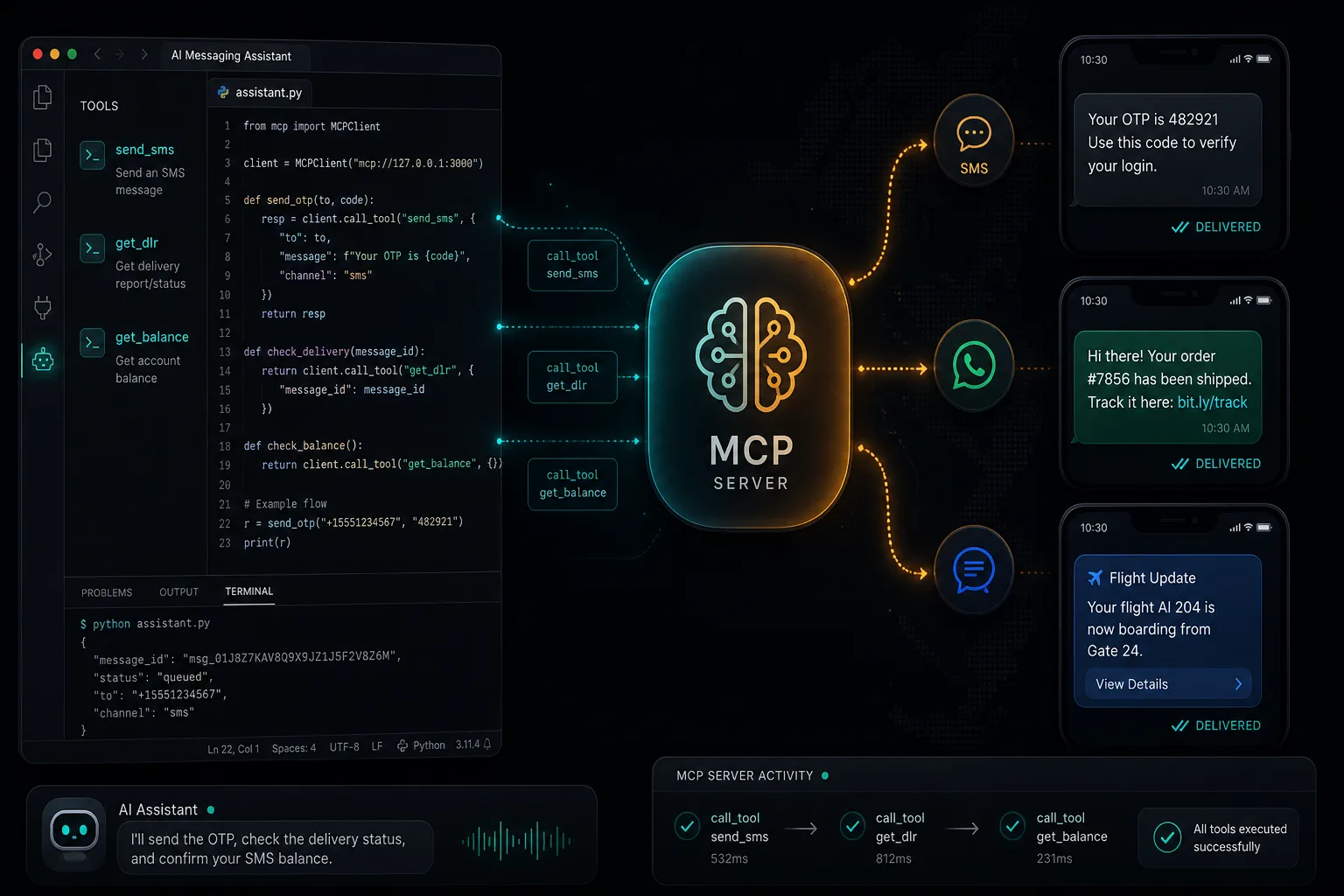
MCP tools are a typed front door to the HTTP API you already expose. WhatsApp, RCS, Telegram, and voice tools appear only when those products are active on the account. Customer-facing bots still belong on the AI Agent Builder. MCP is for operators and internal agents.
- send_sms, send_whatsapp, send_rcs, and send_telegram follow the same rate cards as the panel.
- get_dlr and get_message_status return the delivery path your SMPP or HTTP vendor already reports.
- get_balance reads the wallet. It cannot invent credits or skip payment gateway recharge rules.
- Template lookup respects DLT registrations in India. A mismatched body is rejected, not rewritten.
File-based bulk still belongs on Bulk SMS and RCS via SFTP. MCP is for interactive, tool-sized sends and lookups.
What the System Configures Before a Tool Runs
| Setting | What it controls |
|---|---|
| Transport | Streamable HTTP for remote hosts (OAuth), or a stdio sidecar when the AI app must spawn the server locally. |
| OAuth | Authorization server, redirect URIs, PKCE, resource indicator (this MCP URL), scopes (send vs lookup), token TTL, and refresh rotation. |
| Identity mapping | Each access token maps to one Admin, reseller, or user. Downline OAuth clients cannot debit another tenant wallet. |
| API keys | Optional machine credentials for stdio or CI. Same identity as REST. Not the default for remote HTTP hosts. |
| Tool catalogue | Which send and lookup tools are advertised. Channel tools stay hidden until that product is licensed on the account. |
| Guardrails | IP allowlist, rate limits, DLT template match, and credit check before a message is queued. |
| Audit trail | Host, tool name, arguments summary, message ID, and result are written beside existing API logs. |
Need Cursor, Claude, or a custom MCP client on your SMS panel?
Tell us the host, whether remote MCP should use OAuth with your IdP or panel login, and which channels the tools should cover.
Talk to a SpecialistBuilt for Production Sends, Not a Demo Chat
OAuth identity, same wallet
The bearer token maps to the Admin, reseller, or user record. A downline client cannot call another tenant's tools.
No silent bypass
Expired token, missing scope, empty credits, or a DLT mismatch returns an error to the host. Nothing is queued.
Reconcile with API logs
Match tool-call IDs to message IDs when operations in Mumbai, Dubai, or Nairobi close the day.
See Pricing for license options, or Rent SMPP Application if you want hosted MCP included in a rental stack.
FAQ
MCP Server Integration: common questions
Client Feedback
What Our Clients Say
Our clients run regulated, high-volume messaging infrastructure and prefer not to be named publicly. These testimonials are shared with permission while keeping commercially sensitive details confidential.
We evaluated several messaging platforms before selecting SMPP Center. The deployment flexibility and API capabilities matched our enterprise requirements.
Excellent documentation, responsive technical support, and an enterprise-grade platform that scales as our business grows.
High throughput, intelligent routing, and detailed monitoring have significantly simplified our messaging operations.
The platform has been reliable for business-critical messaging. Multi-connection support and detailed logging have made daily operations much easier.
Names and company details are withheld at our clients' request. This is common among telecom providers, SMS aggregators, fintech companies, and enterprises that consider their messaging infrastructure commercially sensitive.