
SMS gateway software is the layer that turns a message written inside an application, a CRM, a banking system or a marketing platform into an actual text message delivered to a phone, and turns delivery confirmations and replies back into data an application can use. It sits between whatever generates the message and the mobile networks that carry it.
That one-line definition is where most articles on this topic stop. It is not where this one stops, because the definition alone does not help you make a buying decision. The real question every business asks is not "what is an SMS gateway" but "which type of SMS gateway software fits how I actually send messages, at what volume, to which countries, under whose compliance rules." That is the question this guide answers.
How SMS Gateway Software Works
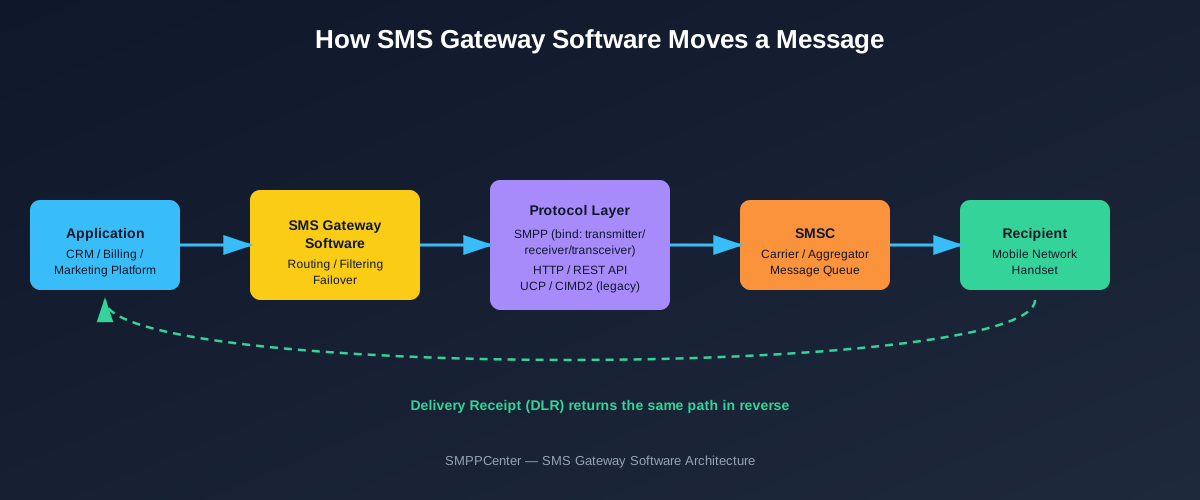
Every SMS gateway, regardless of vendor, moves a message through the same basic path. The quality of an SMS gateway is really measured by what happens at steps 2 and 3: how intelligently it routes traffic, how it handles failures, and how much throughput it can sustain without dropping messages.
The Protocols Behind SMS Gateway Software
Four protocols account for almost all SMS gateway traffic today, and understanding the differences matters more than most buyers realize before they pick a vendor.
A binary protocol holding an open TCP connection between the gateway and the SMSC, sustaining thousands of messages per second. Supports transmitter, receiver, and transceiver sessions — the standard choice for aggregators, resellers, and high-volume OTP traffic.
HTTP/REST API
A stateless request-response model where each message is its own HTTP call. Easier to integrate in any language, no persistent connection to manage — the right default for low-to-medium volume senders.
UCP/EMI
Universal Computer Protocol / External Machine Interface — an older European telecom standard, still used by some legacy SMSC systems and operators running older infrastructure.
CIMD2
Computer Interface to Message Distribution — a legacy protocol historically associated with Nokia SMSC systems, still encountered when integrating older carrier infrastructure.
If you are choosing gateway software today, the practical decision is almost always between SMPP and HTTP. UCP and CIMD2 matter mainly if you are connecting to a specific legacy SMSC that requires them.
The Four Deployment Models, Compared
This is the part of the category that most SMS gateway content skips, and it is the part that actually determines total cost of ownership, control, and scalability.
| Deployment model | How it works | Best suited for | Tradeoffs |
|---|---|---|---|
| Cloud SMS API (e.g. Twilio-style CPaaS) | You call a hosted API; the provider owns the infrastructure, carrier relationships, and routing | Developers and businesses that want to integrate quickly and do not want to manage infrastructure | Ongoing per-message or subscription cost, less control over routing logic, dependent on the provider's uptime and pricing changes |
| On-premise / self-hosted gateway software (e.g. Ozeki-style installed software) | You install software on your own server or VPS and connect it to carriers or aggregators yourself | Businesses that want full control over data, routing, and infrastructure without recurring per-message fees | Requires in-house technical capacity to install, configure, and maintain; you are responsible for carrier relationships and uptime |
| Hardware SMS gateway (SIM-based physical devices) | A physical unit with SIM cards sends and receives SMS directly over the mobile network, no third-party service in the path | Alerting, monitoring, and IoT use cases where independence from any online service is the point | Limited throughput compared to SMPP-based systems, not designed for high-volume commercial campaigns |
| SMPP reseller / aggregator platform (SMPPCenter's category) | Licensed software built specifically to let you become the aggregator: operate your own SMPP client and server, connect to multiple carriers and upstream vendors, and resell capacity to your own downstream users or clients | SMS resellers, aggregators, and companies building a messaging business rather than just sending their own messages | Requires the deepest operational knowledge (carrier relationships, routing, compliance, filtering) but is the only model that lets you build a scalable SMS business rather than just consume one |
Almost every article and vendor page in this category describes only the first two or three models, and treats the fourth, the reseller/aggregator model, as a footnote if it appears at all. That is a meaningful gap, because a large share of the buyers actually searching for "SMS gateway software" are not looking to send their own messages. They are looking to build a business selling SMS capacity to other businesses, and the software they need looks structurally different: it needs SMPP client and server capability, multi-vendor routing, spam and NCPR filtering, tiered user accounts, and reseller billing, not just an API key.
Not sure which deployment model fits your business?
Talk to an SMPP Software Specialist.
Talk to a SpecialistWhich Model Should You Choose?
Single-App Developer
A cloud SMS API is almost always the right starting point. Fast integration, no infrastructure to manage, pay for what you use.
Enterprise IT Team
On-premise gateway software or a cloud API both work; the deciding factor is usually data residency and whether messages must stay on your own infrastructure.
Independent Alerting
A hardware SMS gateway is purpose-built for alerting that cannot depend on any third-party service, though it will not scale to high-volume traffic.
Reseller / Aggregator
You need direct SMPP connectivity to multiple carriers, your own SMPP server for downstream clients, throughput into the thousands of TPS, and account-tiering by traffic type.
Features That Separate Serious SMS Gateway Software From the Rest
Regardless of deployment model, the features below are what actually distinguish gateway software capable of carrying commercial traffic from a basic send-a-text tool.
The Compliance Layer Almost Every SMS Gateway Guide Skips
Choosing SMS gateway software without understanding the compliance obligations attached to your traffic is one of the most common and most expensive mistakes buyers make. The rules differ significantly by region, and a gateway or aggregator that ignores them can get your sender ID blocked or your business fined.
DLT (India)
Any entity sending commercial SMS in India must register its sender ID and message templates on the Distributed Ledger Technology platform mandated by TRAI. Non-matching messages are blocked at the carrier level, not just flagged.
TCPA (United States)
Requires prior consent before sending marketing text messages to US numbers; penalties for violations have run into hundreds of millions in class-action cases. Consent-tracking and opt-out handling need to be built in, not bolted on.
GDPR (European Union)
If your gateway processes personal data of EU residents, GDPR's consent, data-minimization, and data-processing-agreement requirements apply, regardless of where your servers are physically located.
None of these rules are optional extras. They are the difference between an SMS gateway that keeps your sender reputation intact and one that gets your numbers blacklisted after your first large campaign.
Common Mistakes Buyers Make
- Choosing based on advertised throughput alone, without testing sustained performance under real failure conditions (carrier outages, network congestion).
- Ignoring the reseller/aggregator model entirely because most content never mentions it, even when reselling capacity is actually the buyer's real business goal.
- Treating compliance as a launch-week afterthought instead of a selection criterion evaluated alongside features and price.
- Assuming all "SMS API" providers offer equivalent delivery reporting, when DLR accuracy and speed vary significantly between vendors and protocols.
- Underestimating the operational complexity of running your own carrier connections if choosing an on-premise or reseller model without the in-house telecom expertise to support it.
FAQ
Frequently Asked Questions
See SMPPCenter's SMS Gateway Features in Detail
Explore FeaturesClient Feedback
What Our Clients Say
Our clients run regulated, high-volume messaging infrastructure and prefer not to be named publicly. These testimonials are shared with permission while keeping commercially sensitive details confidential.
API integration was straightforward and the support team assisted us throughout deployment. We now manage multiple operator connections from a single platform.
We evaluated several messaging platforms before selecting SMPP Center. The deployment flexibility and API capabilities matched our enterprise requirements.
High throughput, intelligent routing, and detailed monitoring have significantly simplified our messaging operations.
The migration was completed smoothly and the platform has remained stable under heavy production traffic. The flexibility of self-hosting was one of the biggest advantages for us.
Names and company details are withheld at our clients' request. This is common among telecom providers, SMS aggregators, fintech companies, and enterprises that consider their messaging infrastructure commercially sensitive.