
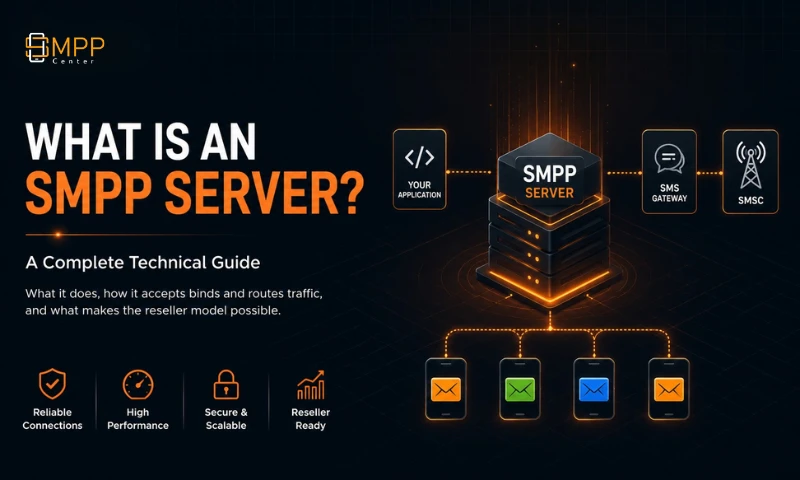
An SMPP server is the piece of software that accepts SMPP connections from other systems, authenticates them, and then queues, routes, and delivers the traffic they submit, along with returning delivery receipts and inbound messages back to whoever sent them. It is the server-side role in every SMPP session, the same role a carrier's own SMSC (Short Message Service Centre) plays toward the businesses connecting to it. If you have already read our guide to SMPP itself, or what an SMPP client does, this page covers the other half: what it takes to be the thing other systems bind to, rather than the thing binding out.
Running your own SMPP server is what separates a business that only sends its own messages from one that can resell messaging capacity to others. It is the single piece of infrastructure that turns SMS gateway software into an aggregator or reseller platform, and it carries a very different set of engineering demands than a client does, mainly because it has to safely serve many different accounts at once instead of just one.
Where the Server Sits in an SMPP Connection
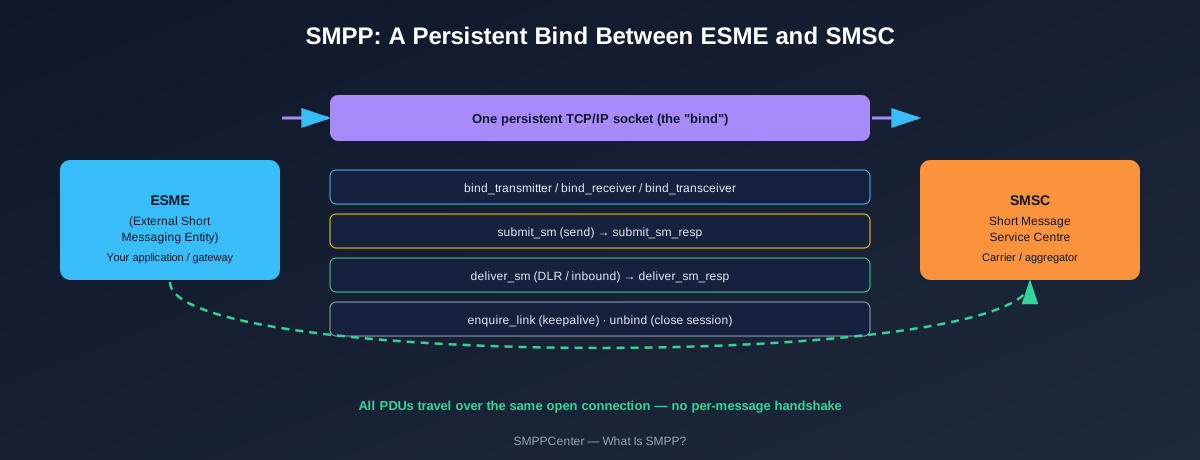
The server never initiates a connection. It listens on a host and port, and waits for clients (ESMEs) to connect to it. Once a client connects and successfully binds, the server is responsible for everything that happens on that session from its side: validating every submit_sm it receives, queuing it, routing it toward its destination, and eventually reporting back what happened.
An SMPP server run by an aggregator or reseller platform, like the one inside SMPPCenter, is not usually the very last stop in the chain. It typically accepts traffic from downstream clients, then hands that traffic to its own upstream SMPP client, which submits it onward to a carrier or another aggregator, the same relationship your own client would have if you were binding directly to a carrier yourself.
What an SMPP Server Actually Does, Step by Step
From the server's side, the same connection lifecycle a client drives looks like this. The server is reactive at every step, responding to whatever the connecting client does, rather than initiating.
- Listen. The server holds a socket open on a defined host and port, ready to accept incoming TCP connections from any client that has been issued credentials.
- Authenticate the bind. When a client sends a bind_transmitter, bind_receiver, or bind_transceiver PDU, the server checks the system_id and password against its own records, along with whether that account's status allows binding at all, such as a suspended or over-limit account, and responds with a bind_resp.
- Accept and validate submissions. For every submit_sm the bound client sends, the server checks it against that account's limits: available credit or balance, permitted sender IDs, message content rules, and any registered template matching a market's regulatory requirements, before accepting it, and responds with a submit_sm_resp.
- Queue and route. Accepted messages are queued and routed onward, commonly through the platform's own upstream SMPP client, toward the carrier or aggregator that will actually deliver it to the handset.
- Report status back. As delivery receipts and inbound replies arrive from upstream, the server maps each one back to the correct downstream account and bind, and delivers it as a deliver_sm to whichever client originally submitted that message.
- Enforce limits continuously. Throughout the session, the server tracks each account's throughput against its allowed TPS, and can throttle or reject further submissions from that specific bind without affecting any other account connected to the same server.
Skip building an SMPP server yourself
Talk to an SMPP Software Specialist about running your reseller or aggregator business on SMPPCenter's SMPP server.
Talk to a SpecialistWhy a Server Is Harder Than a Client: Multi-Tenancy
A client only ever has to represent one identity: your own business, binding out. A server has to safely host many different identities at once, each with its own credentials, credit balance, throughput limit, and routing rules, without letting any one of them see, affect, or borrow capacity from another. That multi-tenant layer is where most of a production SMPP server's real complexity lives.
Do You Need to Run an SMPP Server Yourself?
| Situation | Do you need your own SMPP server? |
|---|---|
| You only send your own traffic | No. You only need an SMPP client, binding outward to whichever platform or carrier you send through. |
| You want to resell capacity to your own downstream clients | Yes. Your downstream clients need something to bind to, with their own credentials, limits, and billing, which is exactly what an SMPP server provides. |
| You are an aggregator taking on sub-resellers | Yes, at scale, with the full multi-tenant billing, routing, and high-availability requirements described above. |
SMPPCenter's SMPP server is what underpins its Admin, Reseller, and User panel tiers: every downstream account gets its own bind credentials and credit balance, so your customers connect to you exactly the way you connect to your own upstream carriers. See SMS Gateway Software for Resellers for the full reseller feature set built on top of it.
SMPP Server vs SMPP Client
A server and a client are opposite sides of the same connection. The client binds outward to send traffic upstream. The server accepts binds from downstream accounts and routes their traffic onward, commonly through its own client. Most serious SMS gateway platforms, including SMPPCenter, run both at once: a client upstream to carriers and vendors, and a server downstream to your own customers or resellers. See What Is an SMPP Client? for the other half of that picture, and SMPP Provider for how SMPPCenter packages both together.
FAQ
Frequently Asked Questions
See SMPPCenter's SMPP Client and Server Features in Detail
Explore FeaturesClient Feedback
What Our Clients Say
Our clients run regulated, high-volume messaging infrastructure and prefer not to be named publicly. These testimonials are shared with permission while keeping commercially sensitive details confidential.
The platform has been reliable for business-critical messaging. Multi-connection support and detailed logging have made daily operations much easier.
High throughput, intelligent routing, and detailed monitoring have significantly simplified our messaging operations.
We evaluated several messaging platforms before selecting SMPP Center. The deployment flexibility and API capabilities matched our enterprise requirements.
The migration was completed smoothly and the platform has remained stable under heavy production traffic. The flexibility of self-hosting was one of the biggest advantages for us.
Names and company details are withheld at our clients' request. This is common among telecom providers, SMS aggregators, fintech companies, and enterprises that consider their messaging infrastructure commercially sensitive.