SMPPCenter publishes both subscription and perpetual license pricing, including the mandatory three year Annual Upgrade Charge most buyers never model. Here is the actual arithmetic, using SMPPCenter’s own published figures.
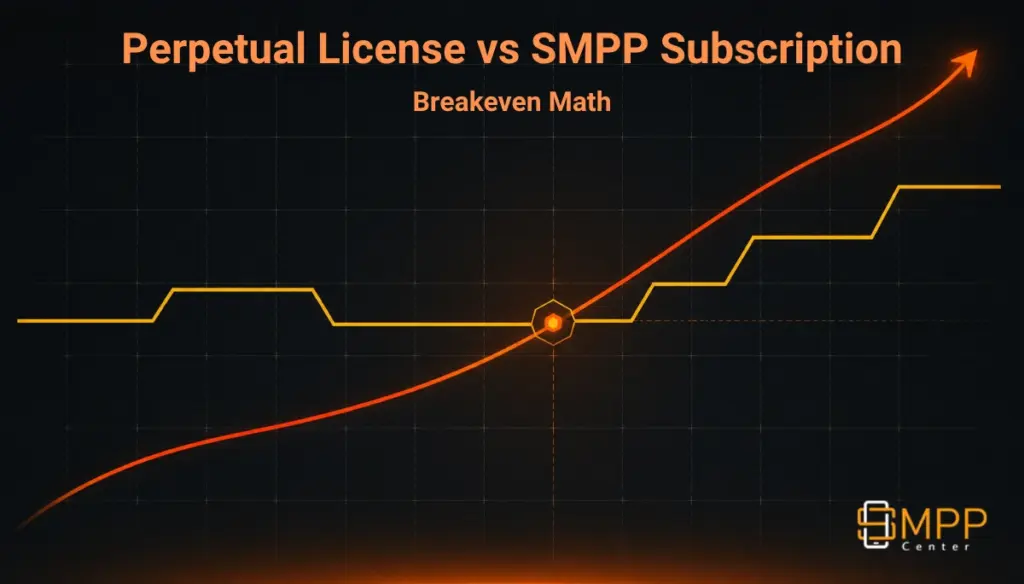
Table of Contents
- The Short Answer
- TL;DR
- Why This Question Comes Up
- The Actual Numbers
- The AUC Variable Nobody Models
- Building the Breakeven Table
- What the Math Leaves Out
- Who Perpetual Actually Fits
- Who Subscription Actually Fits
- How This Differs From the Build vs Buy Guide
- CTA
- What This Article Deliberately Does Not Claim
- FAQs
The Short Answer
Using SMPPCenter’s own published pricing, a perpetual license on the Growth or Scale tier does not clearly beat the monthly subscription until somewhere between four and seven years of ownership, and where in that range it lands depends almost entirely on one line item most buyers skip past: the Annual Upgrade Charge (AUC), which is mandatory for the first three years of a perpetual license and optional after that. Buy the license expecting a one-time payment and you will underestimate the real cost by 50 to 60 percent in year one alone. Model the AUC honestly and perpetual licensing still wins for a specific kind of buyer: one who plans to run the platform for five-plus years and is comfortable freezing the software version once the mandatory upgrade period ends.
TL;DR
- SMPPCenter’s pricing page lists Growth at $399/month ($3,990/year) or a $14,000 perpetual license, and Scale at $749/month ($7,490/year) or a $26,000 perpetual license.
- The perpetual license is not a one-time cost. It carries an Annual Upgrade Charge of $2,100 to $2,800/year on Growth and $3,900 to $5,200/year on Scale, mandatory for the first three years, optional after.
- Modeled honestly, cumulative subscription spend does not cross the perpetual license’s total cost until roughly month 51 to 56 if the buyer drops the AUC the moment it becomes optional (accepting a frozen, unpatched software version), or roughly month 62 to 85 if they keep paying it indefinitely.
- Before three years are up, the subscription is almost always cheaper in raw dollars. Perpetual licensing is a bet on years four through ten-plus, not a way to save money in year one.
- This is a simplified cash-flow comparison, not a discounted cash flow or tax analysis. Treat it as a starting model, not financial advice.
Why This Question Comes Up
SMS aggregators and enterprise messaging teams evaluating SMPPCenter eventually hit the same page: Pricing lists Growth and Scale on both a monthly/annual subscription and a perpetual license, with the perpetual figures sitting quietly under each subscription tier. The instinct is to treat the perpetual number as a bigger, scarier version of a one-time software purchase and mentally divide it by the monthly subscription price to get a rough “months to break even” figure. That instinct produces the wrong answer, because it ignores the recurring Annual Upgrade Charge that comes bundled with a perpetual license and is mandatory for three years regardless of whether the buyer wants new features.
This matters more for an SMPP platform than for most software categories. An SMS aggregator is not buying a productivity tool it can quietly stop paying for; it is buying the piece of infrastructure that binds to upstream carriers, handles throughput throttling, and routes revenue-generating traffic. A licensing decision made on a rough mental estimate, rather than the actual published numbers, is a bad way to commit to five or more years of infrastructure spend.
The Actual Numbers
Every figure below comes from SMPPCenter’s pricing page as published. Figures change; verify before relying on them for a purchase decision.
| Plan | Monthly | Annual (2 months free) | Perpetual License | Perpetual AUC (mandatory years 1-3, optional after) |
|---|---|---|---|---|
| Launch Web | $129 | $1,290 | Not offered | Not offered |
| Launch SMPP | $299 | $2,990 | Not offered | Not offered |
| Growth | $399 | $3,990 | $14,000 | $2,100 to $2,800/year |
| Scale | $749 | $7,490 | $26,000 | $3,900 to $5,200/year |
| Enterprise | Custom | Custom | From $60,000 | Custom |
A $100 one-time setup fee applies across plans, including perpetual licenses, and is waived when a buyer prepays quarterly or annually. It is small enough relative to the license and AUC figures that it does not meaningfully change the breakeven math below, so it is excluded from the model for clarity.
Perpetual licensing is only offered on Growth, Scale, and Enterprise. Launch Web and Launch SMPP are subscription-only, which already tells you something: SMPPCenter is not positioning perpetual licensing as an entry-level option. It is positioned for buyers who have already validated the platform at volume.
The AUC Variable Nobody Models
Here is the detail that changes the entire calculation. According to SMPPCenter’s pricing terms, the Annual Upgrade Charge covers version upgrades, feature releases, and security patches, and it is mandatory for the first three years after a perpetual license purchase, starting immediately, with no year-one waiver. After year three it becomes optional. A buyer who lets it lapse keeps the right to run their current software version, but stops receiving upgrades, releases, or security patches, and per the pricing terms must acknowledge in writing that they are running unsupported software at their own risk. Restarting AUC later means paying for every year it was inactive.
That structure has two direct consequences for a breakeven calculation. First, a perpetual license is not a $14,000 or $26,000 purchase, it is that figure plus a guaranteed three years of AUC on top, which adds $6,300 to $8,400 to the Growth license and $11,700 to $15,600 to the Scale license before any optional years are even considered. Second, after year three the buyer faces a real decision with a real cost tradeoff: keep paying AUC and get a software platform that keeps evolving, or stop paying and accept a frozen version in exchange for a capped, predictable total cost. Most vendor pricing pages do not spell out a mandatory multi-year support obligation this explicitly. Whatever else is true of the decision, buyers who skip this term will build a materially wrong model.
Building the Breakeven Table
The table below compares cumulative cost at month 36 (the point the AUC obligation ends) and shows the range of possible full breakeven points under two scenarios: continuing to pay AUC indefinitely, or dropping it the moment it becomes optional. AUC is billed as a range on SMPPCenter’s pricing page, so each breakeven point is itself a range, not a single month. This uses simple cumulative cash outlay, no discounting, no interest, no tax treatment.
Growth tier ($399/mo subscription vs $14,000 perpetual + $2,100 to $2,800/yr AUC):
| Metric | Low AUC estimate | High AUC estimate |
|---|---|---|
| Subscription cost at month 36 | $14,364 | $14,364 |
| Perpetual cost at month 36 (license + 3 years mandatory AUC) | $20,300 | $22,400 |
| Breakeven if AUC dropped at month 36 (perpetual cost frozen) | ~month 51 | ~month 56 |
| Breakeven if AUC continued indefinitely | ~month 62 | ~month 85 |
Scale tier ($749/mo subscription vs $26,000 perpetual + $3,900 to $5,200/yr AUC):
| Metric | Low AUC estimate | High AUC estimate |
|---|---|---|
| Subscription cost at month 36 | $26,964 | $26,964 |
| Perpetual cost at month 36 (license + 3 years mandatory AUC) | $37,700 | $41,600 |
| Breakeven if AUC dropped at month 36 (perpetual cost frozen) | ~month 50 | ~month 56 |
| Breakeven if AUC continued indefinitely | ~month 61 | ~month 82 |
Two things stand out. At month 36, the subscription is cheaper in every scenario on both tiers, sometimes by a wide margin. That is the opposite of the usual assumption that perpetual licensing pays for itself quickly. And the two tiers produce nearly identical breakeven ranges in months, because the perpetual-to-subscription price ratio SMPPCenter set for Growth and Scale is close to the same multiple (roughly 35x monthly price for the license itself). That consistency is a useful sanity check: it suggests the pricing was built on a common underlying model rather than set independently per tier, which is generally a positive sign about how deliberately the pricing was constructed.
Enterprise perpetual pricing starts “from $60,000” with custom AUC, so this table cannot be completed for that tier from public information. The same framework applies: take the actual quoted perpetual price and AUC, and the quoted custom subscription price, and run the same two-scenario comparison before signing.
What the Math Leaves Out
A cumulative cash-outlay comparison like the one above is a reasonable starting point, not a complete financial analysis, and a few real factors sit outside it entirely.
Money spent later is worth less than money spent now. A finance team evaluating a $14,000 outlay today against $399/month for six years should discount future subscription payments to present value, which favors the subscription more than the raw arithmetic above suggests. The Corporate Finance Institute’s explanation of payback period covers why raw breakeven months and true financial payback are not the same number, and a discounted comparison is worth running before a large perpetual purchase.
Vendor dependency risk cuts in different directions depending on structure. A general industry comparison of perpetual and subscription licensing makes the point that perpetual buyers who stop paying for support are exposed if the vendor discontinues a product line or changes terms, since they are running an increasingly dated version with no contractual path back except paying back-charges for every lapsed year. Subscription buyers face a different risk profile: continuity depends entirely on the ongoing relationship and the vendor’s pricing decisions, with no fallback version to keep running if the relationship ends.
Capital allocation matters independent of total cost. A $14,000 or $26,000 upfront outlay is capital that cannot be spent elsewhere, and for a business scaling reseller accounts or entering new markets, that opportunity cost can outweigh a modest long-run total-cost advantage. This is exactly the kind of tradeoff a company’s own finance function is positioned to weigh, not something a pricing page comparison can settle.
Flexibility to change plans matters more than the math implies. The breakeven table assumes a buyer stays on the same tier for the full period. An aggregator whose volume is genuinely uncertain, particularly one considering reseller account growth, gives up the ability to step down cheaply if a perpetual license turns out to be sized wrong.
Who Perpetual Actually Fits
The breakeven math points toward a narrow but real profile: an organization that has already run SMPPCenter, or comparable infrastructure, long enough to be confident in its volume and tier for the next five-plus years, that has the capital available without straining cash flow, and that is comfortable with the year-three fork in the road, either continuing to pay for ongoing upgrades or accepting a frozen, unsupported version to cap spend. This describes an established SMS aggregator or enterprise buyer standardizing on a platform for the long term more than a company still validating its model. It is also the profile SMPPCenter’s own tier structure implies, since perpetual licensing is not offered on the entry-level Launch tiers at all.
Who Subscription Actually Fits
Everyone else. New aggregators, businesses still finding their volume and reseller footprint, and anyone unwilling to commit five-plus years of certainty to a single infrastructure decision are better served by the subscription, even accepting that it costs more in total dollars if the relationship runs a full decade. SMPPCenter’s own journal piece on monthly rental plans for new SMS aggregators makes a version of this case, focused on lower upfront cost and avoiding staff overhead. That piece does not run the numbers; this article’s job is to show what “lower upfront cost” is actually worth in dollar terms once the full AUC obligation is priced in, not to repeat the qualitative case for renting.
How This Differs From the Build vs Buy Guide
SMPPCenter’s build vs buy learn-hub guide answers a different, earlier question: whether to build SMPP infrastructure in-house at all, versus buying a licensed or SaaS platform from a vendor. It frames “buy” as a single category and does not separate perpetual on-premise licensing from subscription SaaS as distinct sub-decisions, since at that stage of the decision the build-versus-buy question is the one that matters. This article picks up after that decision is already made in favor of buying from SMPPCenter, and answers the next question: subscription or perpetual, and when does the math actually favor one over the other. Read the build vs buy guide first if the open question is still whether to build; read this one once buying is settled and the remaining question is how to pay for it.
Everything above is built from SMPPCenter’s published rate card, not a quote negotiated for a specific account. Before committing to either path, get the actual AUC rate for your tier in writing, confirm whether it is negotiable at your volume, and re-run the breakeven table above with your real numbers instead of the published range.
What This Article Deliberately Does Not Claim
This article does not claim a specific breakeven month, because SMPPCenter publishes AUC as a range, not a fixed figure, and the real number for any given buyer depends on their actual quoted rate, their tier, and whether SMPPCenter offers negotiated terms outside the published bands, which enterprise buyers should assume is possible. It does not model Enterprise tier economics, because Enterprise subscription and AUC pricing are both custom and not published. It does not include a discounted cash flow or net present value calculation, tax treatment, or the value of capital tied up in an upfront purchase; those require a buyer’s own finance function and their actual cost of capital. It does not claim SMPPCenter’s AUC terms are unusual or unusually favorable compared to competitors, since this article did not do a line-by-line comparison against Twilio, Gupshup, or other vendors’ license terms for this specific piece. And it does not factor in the value of features that might differ between subscription and perpetual license versions over time, since SMPPCenter’s pricing page does not state that the two paths diverge in included functionality beyond the AUC-gated upgrade cadence.
FAQs
Does the perpetual license include support?
SMPPCenter’s pricing terms describe the AUC as covering upgrades, releases, and security patches, which is mandatory for the first three years of ownership. The pricing page does not separately break out day-to-day support access from the AUC, so buyers should confirm exactly what support channel access looks like both during and after the mandatory AUC period before purchasing.
Can I switch from subscription to perpetual later, or the reverse?
This is not addressed on SMPPCenter’s public pricing page. Buyers considering a future switch should ask directly and get the terms in writing rather than assuming either direction is available.
Is the AUC negotiable?
Not stated publicly. The pricing page notes that binding terms live in the signed agreement and order form, with the pricing page itself described as a plain-language summary, which suggests there is room for negotiation, particularly at Scale and Enterprise tiers, but this is not confirmed.
What happens to my data and running system if I stop paying AUC after year three?
Per the published terms, the license holder keeps the right to run their current software version but stops receiving upgrades, releases, or security patches, and must acknowledge running unsupported software at their own risk. This article did not find published detail on data handling, backups, or system behavior beyond that point.
Does this math apply to Launch Web or Launch SMPP?
No. Perpetual licensing is not offered on either Launch tier, only on Growth, Scale, and Enterprise, so the comparison in this article does not apply to the entry-level plans.