
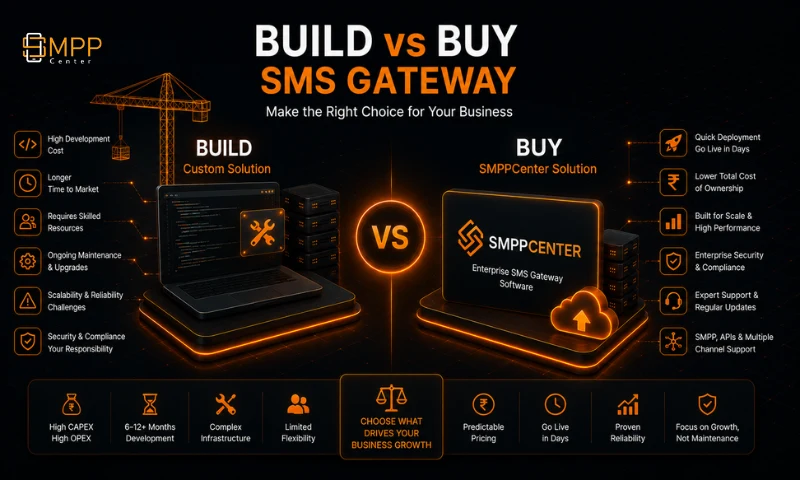
Should You Build Your Own SMS Gateway?
Before anyone compares vendors, there is an earlier question: should this be built in-house at all? An SMPP stack is not conceptually hard to start, but it accumulates real complexity fast, connection pooling, failover across multiple SMSC binds, delivery receipt handling, throughput management, and compliance logic. This guide is deliberately even-handed: building is genuinely the right call in some situations, and the wrong one in most others.
What Building Actually Involves
| Component | Why It's Non-Trivial |
|---|---|
| SMPP client and/or server | Implementing the protocol correctly, including binds, enquire_link keepalives, and PDU sequencing |
| Connection resilience | Automatic reconnect, failover across multiple SMSC binds, and throughput (TPS) throttling per carrier |
| Delivery receipts and status | Correlating submit_sm to deliver_sm across asynchronous, sometimes delayed, carrier responses |
| Routing and least-cost logic | Choosing the right upstream route per destination, with fallback when a route fails |
| Reseller / multi-tenant layer | Only needed if you plan to let downstream clients bind to you - a materially bigger build than sending your own traffic |
| Compliance handling | DLT, NCPR, and similar regional requirements, which shift over time and carry real penalty risk if wrong |
| Ongoing maintenance | Carrier-side changes, edge cases found in production, and being on call when a bind drops |
Which One Should You Actually Do?
Build If
You are at very small, stable volume where a lightweight script to a single carrier genuinely suffices, or your routing needs are unusual enough that no existing product fits, and you have engineering capacity to own it long-term.
Buy If
You want to reach production faster, need a reseller/aggregator layer, are operating at volume where reliability matters, or would rather your team build product than maintain protocol plumbing. See Self-Hosted vs SaaS Messaging Software for the next decision once you've chosen to buy.
Open Source Sits Between the Two
Projects like Jasmin and Kannel are worth treating as a distinct third option, not a subset of "build." They hand you working, tested SMPP code, which removes a large share of the build effort, but you still own deployment, dependency management, patching, and support. It is a real reduction in engineering time, not a full transfer of the operational burden that a licensed, vendor-supported platform takes on. See Open Source vs Commercial SMS Gateway Software for that breakdown, or the direct comparisons at SMPPCenter vs Jasmin and SMPPCenter vs Kannel.
Still weighing build vs buy?
Tell us your volume, timeline, and team capacity, and we will give you a straight, even-handed answer.
Talk to a SpecialistFAQ
Frequently Asked Questions
See SMPPCenter's SMS Gateway Features in Detail
Explore FeaturesClient Feedback
What Our Clients Say
Our clients run regulated, high-volume messaging infrastructure and prefer not to be named publicly. These testimonials are shared with permission while keeping commercially sensitive details confidential.
Excellent documentation, responsive technical support, and an enterprise-grade platform that scales as our business grows.
API integration was straightforward and the support team assisted us throughout deployment. We now manage multiple operator connections from a single platform.
We needed complete control over our messaging infrastructure instead of relying on a hosted provider. The platform has delivered excellent performance and reliability.
High throughput, intelligent routing, and detailed monitoring have significantly simplified our messaging operations.
Names and company details are withheld at our clients' request. This is common among telecom providers, SMS aggregators, fintech companies, and enterprises that consider their messaging infrastructure commercially sensitive.