SMPPCenter will build you a native iOS or Android app wired to your existing SMS, WhatsApp, or voice setup for $1,500 to $5,000 per platform, plus $100 to $300 a month in maintenance. Here’s what that price actually buys, and why it’s nowhere close to the cost of building a messaging app from the ground up.
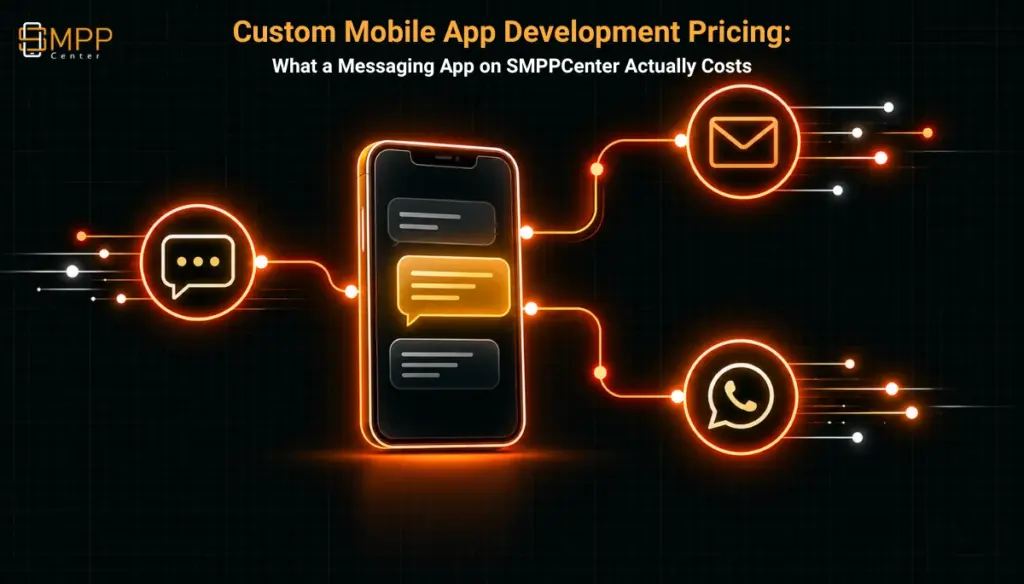
Table of Contents
- The Short Answer
- TL;DR
- What You’re Actually Buying
- The Pricing Table, Channel by Channel
- iOS and Android Are Priced Separately
- What’s Included, What Isn’t
- The Monthly Maintenance Line Nobody Budgets For
- Store Accounts and Who Owns What
- How This Compares to Building a Messaging App From Scratch
- Who This Is Actually For
- Next Steps
- FAQs
The Short Answer
SMPPCenter will build you a native iOS or Android app that talks to your existing SMS, WhatsApp, voice, or other messaging setup, priced per platform and per channel: $1,500 for one channel, up to $5,000 for four, with channels beyond four priced similarly but not listed. Monthly maintenance runs $100 to $300 depending on how big the app is. That’s cheap by app development standards, and it should be, because you’re not paying anyone to build a messaging backend. You already have one. You’re paying for a native front end wired to it.
That distinction matters more than the price tag. If you’re picturing a from-scratch consumer app with its own infrastructure, this isn’t that, and it was never meant to be.
TL;DR
A single-platform, single-channel app costs $1,500 one-time. Add channels and the per-channel price drops: two channels is $2,500 ($1,250 each), three is $3,750, four is $5,000, all at an effective $1,250 per channel once you’re past the first one. Android and iOS are quoted and built separately, though a combined quote for both comes in under double the single-platform price (the site doesn’t publish that combined figure, so you’ll need to ask for it directly). Maintenance is $100 to $300 a month on top of the build, covering OS updates, API changes, store compliance, and security patching, not new features. You own the app and get the source code, same as SMPPCenter’s WordPress and WooCommerce plugin work. Store developer accounts (Apple’s $99/year, Google’s $25 one-time) are registered in your name and billed to you directly. This is a shell app over infrastructure you already pay for elsewhere on the platform, which is exactly why it costs a fraction of what a ground-up messaging app build runs.
What You’re Actually Buying
It’s worth being precise about what’s being built here, because the price only makes sense once you separate the app from the platform underneath it.
SMPPCenter‘s messaging infrastructure already exists: the SMPP server, the HTTP API, the WhatsApp Business integration through Airtel, the delivery reporting, the templating engine, the DLT compliance layer, all of it. That’s the product you’re already paying for through whichever pricing tier you’re on. The mobile app service doesn’t rebuild any of that. It builds a native iOS or Android front end that calls into it: a branded interface your team, your resellers, or your end customers can install on a phone instead of logging into the web panel or hitting the API directly.
That’s why SMPPCenter’s mobile app development service describes itself as focused “exclusively” on messaging-related app development. It’s not a general app-dev shop quoting you for a ride-sharing app or a loyalty program. It’s building a window into infrastructure that’s already running. Development is native on each platform (Swift and Objective-C for iOS, targeting iOS 15 and up; Kotlin and Java for Android, targeting Android 8.0 and up), not a cross-platform framework, even though the service description mentions “cross-platform experience” as a general claim about the team rather than a technical choice for your app. If you need the two platforms to come from one shared codebase (React Native, Flutter, that kind of thing), that’s a conversation to have before you scope the project, not an assumption to make from the pricing page.
The channels the app can carry mirror what the platform already supports: two-way SMS, bulk messaging and delivery reports through the SMPP or HTTP API, WhatsApp Business API messaging including rich media and template messages, and voice features like OTP verification and call management. The pricing page’s own definition of a “channel” widens that slightly to include RCS as an option too, consistent with RCS being a supported channel elsewhere on the platform. Push notifications ride on Apple’s APNs and Google’s Firebase Cloud Messaging, which is standard for any native app and not something unique to this build.
The Pricing Table, Channel by Channel
Here’s the published one-time build pricing, per app (meaning per platform, which the next section covers):
| Channels in the app | One-time build cost | Effective cost per channel |
|---|---|---|
| 1 | $1,500 | $1,500 |
| 2 | $2,500 | $1,250 |
| 3 | $3,750 | $1,250 |
| 4 | $5,000 | $1,250 |
The pattern is obvious once you see it: the first channel costs more on its own because it’s absorbing the baseline app shell, navigation, authentication, and store submission work. Every channel after that adds a flat $1,250. Whether that pattern holds at five, six, or more channels isn’t stated. If your use case needs a fifth channel, that’s a number you’ll have to get quoted directly rather than infer from the table.
All of this is in US dollars and excludes applicable taxes, same convention as the rest of SMPPCenter‘s pricing pages.
iOS and Android Are Priced Separately
The table above is per app, and “per app” here means per platform. An iOS build and an Android build are two separate quotes, each following the same channel-based pricing. Want a four-channel app on both platforms? That’s not a single $5,000 line item, it’s two builds.
The one piece of good news: the page explicitly says a combined Android-plus-iOS quote comes in lower than simply doubling the single-platform price, acknowledging the real overlap in design, API integration work, and testing between the two builds. What it doesn’t do is publish that combined number. If you’re planning both platforms from the start, say so when you request a quote, because asking for iOS pricing and Android pricing separately and adding them together will overstate what you’d actually pay.
What’s Included, What Isn’t
The build covers a defined set of core features: push notifications with scheduling, segmentation, and delivery tracking; API integration across SMPP, HTTP/REST, the WhatsApp Business API, voice call APIs, and listed protocols like WebSocket and GraphQL for anything custom; real-time messaging; media sharing; message scheduling; basic user management; analytics; multi-language support; and end-to-end encryption, described in general terms rather than with a named protocol or implementation.
Beyond that, there’s a list of features the page describes as things the app “can include” rather than things it does by default: chatbot integration, message templates, group messaging, in-app search, cloud backup, dark mode, offline message queuing, voice messages, location sharing, and read receipts. Treat that list as a menu, not a default feature set. If you want dark mode or offline queuing, scope it explicitly, because the base price isn’t guaranteed to include it.
Development follows a seven-stage process: discovery and planning, design and prototyping, development, API integration, testing and QA, deployment to the App Store and Google Play, and ongoing support. What’s not stated anywhere is a timeline for any of those stages, a minimum project size, or a team size you’re being allocated. If scheduling matters to your launch plans, that’s a question for the sales conversation, not something you can back into from the public pricing.
One more honest point: the testimonials on the mobile app development page are about SMPPCenter’s messaging platform generally, not about app builds specifically, and none of them are attributed to a named company. That’s not unusual for a service line this new, but it means you’re evaluating the build quality on the process description and your own due diligence, not on app-specific case studies.
The Monthly Maintenance Line Nobody Budgets For
The one-time build price gets all the attention, but the recurring cost is the one that actually adds up over a few years. Maintenance runs $100 to $300 a month, billed separately from the build, and where you land in that range depends on the app’s channel count and how many platforms you’re maintaining.
What that fee covers: OS and API updates, store compliance changes (Apple and Google both change submission requirements often enough that this is a real, recurring task), dependency and security patching, and basic monitoring. What it doesn’t cover: new features. If you decide six months in that you want group messaging added, that’s quoted and billed as its own project, not folded into the maintenance fee.
Run the math over three years on a mid-range app (say, $200/month maintenance) and you’re looking at roughly $7,200 in maintenance against a one-time build cost that’s likely in the $2,500 to $5,000 range per platform. The maintenance isn’t a rounding error. It’s worth asking, before you sign anything, exactly what’s included at your specific maintenance tier and what would push you to the next one.
Store Accounts and Who Owns What
Two ownership points matter here, and both work in the buyer’s favor.
First, the app itself is yours. The pricing page states the app is owned by you, per the project brief, and handed over as source code, the same model SMPPCenter uses for its WordPress and WooCommerce plugin development work. You’re not locked into SMPPCenter to keep the app running if you later want to bring development in-house or hand it to another vendor, though you’d obviously lose the maintenance relationship and whatever institutional knowledge came with it.
Second, the App Store and Google Play developer accounts are registered in your name, not SMPPCenter’s. That means you’re the one paying Apple’s $99 annual Developer Program fee and Google’s $25 one-time Play Console registration fee directly, and it means you (not a vendor) hold the account that can be suspended, reviewed, or escalated with Apple and Google if something goes wrong post-launch. That’s the right structure for a business building a long-term asset. It also means you need to actually set those accounts up before development can proceed to the deployment stage, so build the lead time for account verification (Apple’s in particular can take a few days) into your launch timeline.
How This Compares to Building a Messaging App From Scratch
This is the number that makes the SMPPCenter pricing make sense, and it’s worth stating plainly because the gap is large enough to cause confusion if you’ve gotten a quote from a general app development shop.
Industry estimates for building a native messaging app from scratch, meaning the app plus a real backend built to support it, run roughly $40,000 to $200,000 depending on complexity, with a 3 to 9 month timeline. A basic native iOS app alone is commonly quoted around $35,000 to $65,000; a basic native Android app around $18,000 to $45,000. A WhatsApp-style messaging product with its own infrastructure lands in the $50,000 to $200,000 range. Maintenance on a from-scratch build is typically budgeted at 15 to 25 percent of the original build cost per year, which on a $100,000 app is $15,000 to $25,000 annually, not $1,200 to $3,600.
The difference isn’t that SMPPCenter is doing the same work for less. It’s that the backend cost, which is most of that $40,000-plus figure, is already sunk into the platform you’re subscribed to. You’re not paying to build message queuing, delivery tracking, a carrier integration layer, DLT compliance handling, or even something adjacent like payment gateway integration for wallet top-ups, because that already exists and you’re already paying for it through your plan. The mobile app fee is paying for exactly one thing: a native front end wired to infrastructure that’s already built and already running. That’s a fundamentally smaller scope than a from-scratch build, and the price reflects that.
If you need a messaging app that’s genuinely independent of SMPPCenter’s backend, something you could run even if you cancelled your SMPPCenter subscription, this service isn’t that, and no amount of channel-stacking in the pricing table gets you there. That’s a different, much larger project with a different vendor relationship.
Who This Is Actually For
Three kinds of buyers get real value here, and it’s worth being specific about each rather than treating this as a generic upsell.
A reseller running a white-label SMS or WhatsApp business for its own downline customers might want a branded app its resellers or their end users can install, instead of pointing everyone at a generic web panel. The per-channel pricing scales naturally here: a reseller offering just SMS might start with the single-channel build, and add WhatsApp or voice later as separate paid increments rather than committing to all four channels upfront.
A bank, fintech, or other enterprise running OTP and transactional messaging through SMPPCenter might want a staff-facing or customer-facing app for voice OTP management or real-time delivery monitoring, something more controlled than giving every stakeholder web panel access.
A CRM or SaaS company that already embeds SMPPCenter’s messaging into its own product via the API or the MCP server integration might want a companion mobile app for its own end users, layered on top of the same backend its web product already calls.
What this isn’t for: a business that just wants a mobile-friendly way to use the existing admin panel (that’s what the web panel’s responsive design and any mobile browser access already handle, at no extra cost) or a business trying to build the next consumer messaging app as a standalone product. For the first case, you don’t need this service at all. For the second, see the previous section. This is a middle-ground product, and it’s priced like one.
Next Steps
If a branded mobile front end makes sense for your setup, the right next step is a quote request specifying your platforms (iOS, Android, or both) and your channel count, since neither the combined-platform rate nor pricing past four channels is published. Check SMPPCenter’s pricing page for the current per-channel table before that conversation, and if you’re still weighing whether a custom app is the right investment versus staying on the web panel and API, SMPPCenter’s own positioning is a reasonable starting point for what the underlying platform already covers without an app layer on top.
FAQs
Does the $1,500 to $5,000 price include both iOS and Android?
No. That table is per platform. A combined quote for both is priced lower than doubling the single-platform cost, but the actual combined figure isn’t published, so request it directly if you need both.
Can I add a channel later instead of paying for all four upfront?
The pricing structure (first channel at $1,500, each additional channel at a flat $1,250) suggests incremental builds are supported, but the page doesn’t explicitly confirm whether adding a channel to an already-shipped app is priced the same as including it from day one, or whether it carries additional integration cost for retrofitting. Ask before assuming either way.
Who pays the Apple and Google developer account fees?
You do, directly to Apple and Google, because the accounts are registered in your name. Apple’s Developer Program is $99 a year; Google Play Console registration is a $25 one-time fee.
Is this the same thing as making the existing web panel mobile-friendly?
No. This builds a separate native app. If all you need is panel access from a phone’s browser, that’s a different (and free) question to ask your account contact, not a reason to commission a custom app.
Does maintenance cover adding new features after launch?
No. The $100 to $300 monthly maintenance fee covers OS and API updates, store compliance changes, and security patching. New feature requests are scoped and quoted as separate work.
Could I build the same app with a general app development agency instead?
You could, but you’d likely be quoted for building a messaging backend as part of that project too, which is where the $40,000-plus from-scratch estimates come from. The SMPPCenter price is low specifically because the backend is already built and already running as part of your subscription. A general agency quote for “just the app” wired into SMPPCenter’s existing API is a more apples-to-apples comparison, but that’s effectively what this service already is.
More from our blog
Custom WordPress SMS Plugin Development: What You’re Actually Buying
How SMPPCenter’s Plan Builder Actually Recommends a Tier
Quiz SMS: A Resellable Interactive Engagement Channel for Aggregators and Brands
Why SMPPCenter Has No Public API Reference, and What You Get After Purchase
SMS Delivery Speed Analytics and Reseller Consumption Reporting for Aggregators