Most SMS gateways stop at text. SMPPCenter‘s Voice Call software adds two genuinely different things over a phone call instead: one-way bulk broadcast calls (OBD) and a dedicated Voice OTP action for reading a one-time code aloud. Neither one is IVR, and the difference matters if you’re evaluating this for a bank, fintech, or resale business.
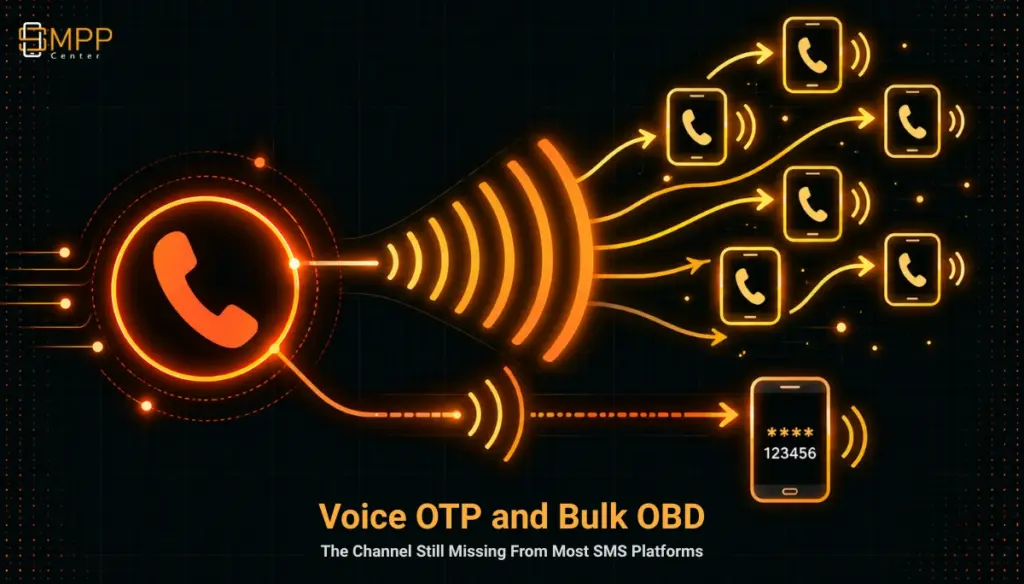
Table of Contents
- The Short Answer
- TL;DR
- What Bulk OBD Actually Is, and Isn’t
- Where Voice OTP Fits In
- Why Banks and Fintechs Add a Voice Fallback to SMS OTP
- The Reseller Angle: a Billable Channel That Isn’t SMS, WhatsApp, or RCS
- What’s Not Published Yet, and What to Ask
- Next Steps
- FAQs
The Short Answer
SMPPCenter’s Voice Call Software does two separate jobs over a phone call, not one. The first is bulk OBD, an outbound dialer that plays a pre-recorded message to a list of numbers, one-way, no interaction, structurally closer to a bulk SMS blast than to a phone tree. The second is Voice OTP, a distinct action inside the same plugin that places a single call to read a one-time passcode aloud to one number at a time, the voice equivalent of a transactional OTP text. Neither one is IVR. There’s no menu, no “press 1 for billing,” no keypress capture, no branching call logic anywhere in this feature. For a bank or fintech evaluating this, Voice OTP is the piece that matters most, usually as a fallback when SMS OTP delivery can’t be guaranteed. For an aggregator or reseller, bulk OBD is the piece that matters, because it’s a genuinely new channel to resell that isn’t just SMS with a different name.
TL;DR
Bulk OBD and Voice OTP live in the same plugin and share the same underlying voice-calling mechanism, but they’re used completely differently. OBD sends a pre-recorded broadcast to many numbers from an uploaded list or a selected group, the way you’d run an SMS campaign, except the recipient’s phone rings and plays audio instead of buzzing with a text. Voice OTP is triggered one call at a time, per transaction, specifically to read a short numeric code aloud, the way a bank would use it when an SMS OTP hasn’t been confirmed delivered or when a customer needs a voice-accessible alternative. Neither does anything interactive. There’s no dedicated public page for either capability on smppcenter.com as of this writing, which is a real gap given how often regulated senders ask about voice as an OTP fallback channel.
What Bulk OBD Actually Is, and Isn’t
The plugin’s own product description is short: send bulk voice calls, compatible for white label resellers and users, paid add-on. That phrasing is generic enough to mean almost anything, so it’s worth being precise about what it actually does.
Bulk OBD is a one-way broadcast. You build a list of numbers, either by typing them in directly (comma-separated, line-separated, or colon-separated, same formats SMPPCenter already supports for bulk SMS), by selecting one or more existing groups, or by uploading a file in CSV, XLS, XLSX, TXT, or ZIP format, the same upload options already documented for bulk SMS sends. Once that list is built, the platform dials every number in it and plays a pre-recorded audio message. The person on the other end listens. That’s the entire interaction. There’s no menu afterward, no option to connect to an agent, no way to branch the call based on anything the recipient does.
This is worth stating plainly because it’s the most common misreading of a feature like this: a “voice call” product doesn’t automatically mean interactive voice response. IVR, in the conventional sense, means the caller can press keys to navigate a menu, and the system branches the call flow based on that input, “press 1 for account balance, press 2 to speak to an agent,” that kind of thing. SMPPCenter doesn’t have that. If a prospect’s evaluation checklist includes DTMF menu trees or branching logic, the honest answer is that this platform doesn’t do it today, and no amount of reframing “bulk voice” changes that.
What it does have is more operational depth than a bare broadcast call might suggest. The same plugin exposes scheduling, the ability to queue a voice send for a future date and time up to whatever the platform’s general scheduling window allows, along with the ability to list, update, or cancel a scheduled voice send by its transaction ID. There’s also a voice library, a place to save an uploaded audio clip once and reuse it across multiple sends rather than re-uploading the same file every time, and delivery-report lookups by transaction ID, so a send’s outcome can be tracked the same way an SMS DLR would be. None of that is interactivity. It’s the scaffolding you’d expect around any bulk-send product, just applied to audio instead of text.
For a bank or fintech, the realistic use cases for bulk OBD sit closer to EMI and loan repayment reminders, service disruption notices, fraud-alert broadcasts to an affected customer segment, or collections follow-up calls, situations where a message needs to reach someone who might not read a text promptly, but doesn’t need to interact with anything once they pick up. For a reseller, the honest pitch is that it’s another billable broadcast product sitting next to SMS, WhatsApp, and RCS, not a replacement for any of them.
Where Voice OTP Fits In
Voice OTP isn’t a separate plugin or a separate purchase path that happens to share a name. It’s a distinct action documented inside the same Voice Call Software‘s own API reference, listed under its own heading separately from the bulk broadcast actions, labeled plainly as sending a voice OTP by PIN. Mechanically, that puts it in a different category from everything described above: instead of dialing a list, it dials one number, once, in response to a single authentication event, and reads a short numeric code aloud. It’s the voice equivalent of a transactional OTP SMS, not a scaled-down broadcast.
That distinction matters for how you’d actually use it. Bulk OBD is something you queue ahead of time against a list. Voice OTP is something your own system would call in real time, the moment a customer needs a code, the same way you’d call an SMS OTP API today. The trigger is a login attempt or a transaction, not a campaign schedule.
One detail isn’t confirmed publicly and is worth asking about directly before you build around it: whether the OTP code is spoken using a pre-recorded set of digit clips stitched together, or generated dynamically through text-to-speech for each code. Either approach would work, but they have different implications for setup time, supported languages, and whether SMPPCenter needs anything configured per-account before Voice OTP calls can go out. Don’t assume either answer, confirm it with sales or support before scoping an integration.
What is clear is that this sits inside the same plugin as bulk OBD rather than being a separate product with its own pricing page or its own onboarding flow. If you’re already using SMPPCenter for bulk voice broadcasts, Voice OTP is very likely available through the same account and the same underlying integration, not a second thing to go procure.
Why Banks and Fintechs Add a Voice Fallback to SMS OTP
SMS is still the default channel for one-time passcodes, and for most transactions, it works fine. The reason regulated institutions keep adding a second channel anyway comes down to a fairly simple fact: SMS OTP delivery isn’t guaranteed, and a failed OTP during a login or a payment isn’t a minor inconvenience, it’s an abandoned transaction and, often, a support call.
Industry reporting on SMS delivery in India gives a rough sense of the gap. Delivery on properly DLT-registered routes is commonly cited around 97 to 99 percent, which sounds high until you remember that’s still one failure in every 35 to 50 messages at best, and that figure drops sharply, into the 60 to 80 percent range, on non-DLT-compliant routes. Baseline failure rates in the low single digits are typical even on good routes, and they spike during high-traffic periods, festival seasons, major sporting events, or monsoon-related network disruptions are all cited as recurring stress points. None of these figures are SMPPCenter-specific; they describe the Indian SMS delivery ecosystem generally, and they’re worth treating as directional rather than exact, since the source for most of this reporting is vendor content rather than an independent regulator or carrier disclosure.
There’s a second, less obvious failure pattern that shows up in published case studies on OTP delivery at scale: single-channel dependence. A fintech or lender relying on one SMS vendor or one carrier route has no fallback when that specific route has a bad day, whether from a vendor outage, a DLT template mismatch that silently blocks a send with no delivery receipt at all, or ordinary congestion during a peak sending window. The documented failure pattern in those cases isn’t a flat background rate, it’s a cluster, a burst of failed OTPs concentrated around a specific outage or event, which is exactly the kind of failure a single text-only channel has no way to catch or route around on its own.
Voice is one of the channels institutions reach for specifically because its failure modes don’t fully overlap with SMS’s. A number can fail to receive an SMS because of a spam filter, a DLT template mismatch, or carrier-side congestion, and still be perfectly reachable by a phone call, since none of those mechanisms apply to a voice circuit the same way. Voice also covers an accessibility gap SMS doesn’t: a customer on a basic handset, or one who has trouble reading a text quickly under pressure during a transaction, can still hear a code read aloud.
It’s worth being precise about what SMPPCenter actually offers here versus what the fallback pattern described above implies. SMPPCenter doesn’t publish a packaged “send SMS OTP first, automatically fall back to voice if undelivered” orchestration product. Voice OTP is a channel, callable on its own through the plugin’s API, not a bundled failover workflow that triggers itself. A bank building this pattern would be the one wiring the logic: send the SMS OTP, watch for delivery confirmation within whatever time window makes sense for the transaction, and call the Voice OTP action themselves if that confirmation doesn’t arrive. That’s a straightforward integration, but it’s work on the buyer’s side, not something switched on by a setting.
The Reseller Angle: a Billable Channel That Isn’t SMS, WhatsApp, or RCS
The plugin’s own description calls out white-label resale directly: compatible for white label resellers and users. That’s a meaningful detail for anyone running an aggregator or reseller business on top of SMPPCenter, because it means bulk OBD isn’t gated as an admin-only internal tool, it’s built to be sold downline the same way SMS, WhatsApp, RCS, and Telegram credit already are.
The appeal for a reseller is straightforward: it’s a genuinely different channel, not a repackaged version of something already being sold. A client who’s already buying SMS and WhatsApp credit doesn’t have a voice broadcast option today unless the reseller adds one, and the use cases line up with categories resellers already sell into: collections and repayment reminders for lending clients, service outage and maintenance notices, appointment or renewal reminders, and civic or public-information broadcasts for government-adjacent accounts. None of those cannibalize existing SMS or WhatsApp spend, since a voice call reaches the recipient differently and often gets used alongside a text rather than instead of one.
Whether Voice OTP specifically extends to white-label resale the same way bulk OBD does isn’t stated anywhere in the plugin’s own description. The white-label line is attached to the bulk voice capability, not called out separately for the OTP action, so that’s a distinction worth confirming before promising a downline client both pieces under the same resale terms.
What’s Not Published Yet, and What to Ask
None of this is listed on SMPPCenter’s pricing pages or its channel pricing breakdown as of this writing, so go in with specific questions rather than assumptions:
- Is bulk OBD and Voice OTP priced per call, per minute, or bundled into an existing plan? Neither appears on the pricing or pricing/channels pages, so confirm directly with sales.
- Is the OTP audio generated dynamically per code, or built from pre-recorded digit clips? This affects language support and whether anything needs configuring per account.
- What languages and accents are available for both bulk OBD playback and Voice OTP?
- Does Voice OTP support a retry, calling again if the first attempt goes unanswered, the way SMS delivery retries work?
- Do the delivery-report lookups for voice distinguish “answered and played” from “rang out unanswered,” or do they only confirm the call connected?
- Does white-label resale extend to Voice OTP specifically, or only to bulk OBD, given the plugin’s description only names white-label resale in connection with bulk voice?
- Is there a maximum message length or duration for a pre-recorded OBD broadcast, the way SMS has a character-count structure?
Next Steps
If SMS OTP delivery failures are already showing up as support tickets or abandoned transactions, that’s worth quantifying before deciding whether a voice fallback is worth building. It’s also worth reading in the context of SMPPCenter’s existing OTP-focused content and the two-factor authentication overview, since both cover the SMS side of the same authentication problem this channel is meant to supplement, not replace. For banks and fintechs specifically, the on-premise and private-cloud deployment guidance for regulated senders and the RBI-aligned messaging guidance are worth reviewing alongside this. SMPPCenter’s pricing page covers the tiers this would sit alongside, and why SMPPCenter covers how the platform positions itself against other SMPP and CPaaS vendors on channel breadth.
FAQs
Does SMPPCenter offer IVR?
No. Bulk OBD and Voice OTP are both one-directional. There’s no DTMF menu, no keypress capture, and no branching call logic anywhere in this feature. If an evaluation specifically requires interactive phone-tree capability, this isn’t it.
Is Voice OTP a separate purchase from bulk voice broadcasting?
Not based on the plugin’s own structure, both actions live inside the same Voice Call Software. Whether billing separates the two usage types isn’t published, so confirm the exact billing split with sales before scoping a deployment.
Can SMPPCenter automatically fall back to a voice call if an SMS OTP fails to deliver?
Not as a packaged, automatic workflow. Voice OTP is a callable action your own integration would trigger; the logic that watches for an unconfirmed SMS OTP and decides to call Voice OTP instead has to be built on the buyer’s side.
Does WhatsApp OTP cover the same gap as Voice OTP?
They’re different fallback channels solving a similar problem from different angles. WhatsApp requires the recipient to have an active WhatsApp account reachable on that number; voice works on any phone that can receive a call, smartphone or not. SMPPCenter’s WhatsApp Business API capabilities are documented separately and aren’t the same mechanism as this one.
Are bulk OBD calls subject to the same do-not-disturb rules as commercial SMS in India?
Commercial voice calls fall under the same regulatory framework that governs unsolicited commercial communication in India, which covers both SMS and voice. The specifics of how that applies to a given OBD use case, especially the distinction between transactional and promotional calls, are worth confirming with your own compliance counsel rather than assuming the SMS-side rules in SMPPCenter’s NCPR/DND coverage translate one-to-one to voice.
More from out Blog
Junk Number Filtering: Cutting DLT and Carrier Costs Before a Message Ever Leaves the Queue
TRAI URL, APK and Callback Number Whitelisting: What Every SMS Template Actually Needs
Running a CRM, E-Commerce, and Spreadsheet Connector Together on One SMPP Center Account
SMPPCenter’s WhatsApp Business API: Airtel BSP, Templates, and the 2025 Pricing Shift Explained
SMPPCenter’s Default 10 TPS Limit, and How the Pricing Tiers Actually Raise It