A technical breakdown of how reseller tiers, the Reseller API, credit control, and compliance propagation work on a licensed SMPP platform, for aggregators evaluating whether to run their own reseller network.
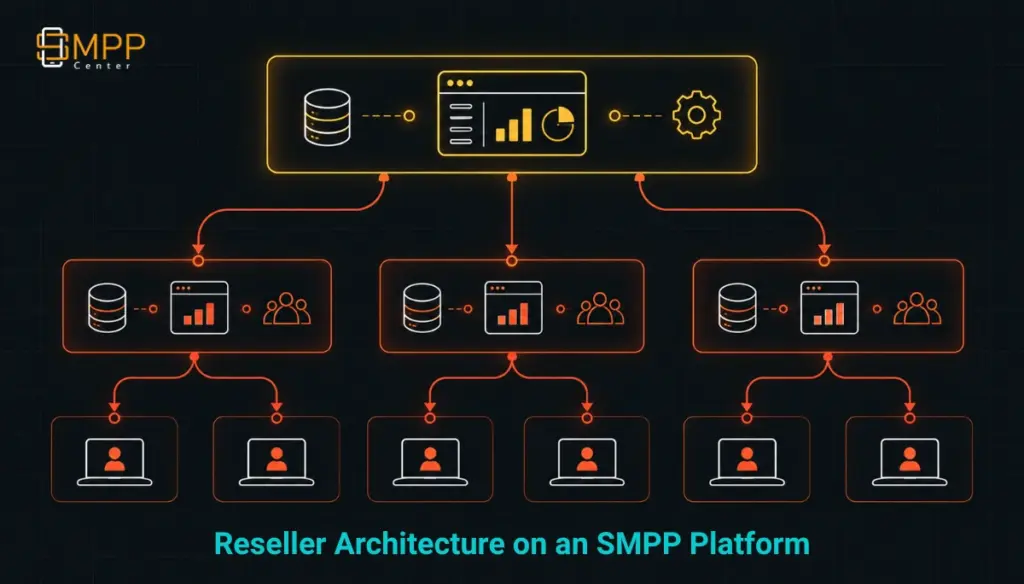
Table of Contents
- The Short Answer
- TL;DR
- The Three Tiers: Admin, Reseller, User
- The Reseller API: What Programmatic Control Actually Means
- Credit and Rate Plans: The Money Layer
- Branding Boundaries: What White Label Does and Doesn’t Cover
- Compliance Propagation Across Sub-Accounts
- What the Reseller Account Limits by Tier Actually Mean
- The Operational Responsibility Side of Being a Reseller
- SaaS Rental vs Self-Hosted for a Reseller Business
- What This Deliberately Does Not Claim
- Next Steps
- FAQs
The Short Answer
A reseller account on a licensed SMPP platform is a scoped administrative layer sitting between the platform owner and end customers, not a separate copy of the software. The reseller gets its own branding, its own sub-customers, its own credit pool, and an API to manage all three programmatically, while the platform owner retains ultimate control over the infrastructure, the SMPP binds to upstream carriers, and the compliance rules that apply to every account underneath. Pricing tiers cap how many reseller accounts a license includes (10 on Growth, 100 on Scale, unlimited on Enterprise), which in practice caps how large a downstream sales network a single license can support before an upgrade is required.
TL;DR
- Reseller platforms typically run a three-tier model: Admin (platform owner), Reseller (sub-agent), User (end customer), each with a narrower slice of control than the tier above it.
- SMPPCenter’s Reseller API covers credit management (read history, add, remove) and user management (create, update, generate or reset password, read profile), letting a reseller run their own portal or automation without a support ticket for every routine action.
- Credit and rate plans are the actual mechanism resellers use to make money: they buy capacity at a wholesale rate and set retail pricing for the accounts under them.
- White-label branding is confirmed to cover logo, text logo, favicon, and theme color, plus an admin-controlled fallback-inheritance setting for pointed domains; deeper page customization is a separate custom arrangement, not a self-service toggle.
- NCPR/DND scrubbing and spam-word filtering apply automatically to every reseller and user underneath an account, which means compliance is inherited, not something each sub-account configures from scratch.
- Reseller account limits by tier are 10 (Growth), 100 (Scale), and unlimited (Enterprise), a real constraint for anyone planning to build a large downstream network.
- Taking on reseller-level access means taking on reseller-level responsibility: the same admin capabilities that make sub-account management convenient (password resets, credit adjustments, rate-plan changes) also put a reseller in the position of a data controller for everyone underneath them.
The Three Tiers: Admin, Reseller, User
Most multi-tenant SMS platforms, SMPPCenter included, are built around a three-tier account hierarchy rather than a flat customer list. The platform owner sits at the top as Admin, with control over the underlying infrastructure: the SMPP binds to upstream carriers and aggregators, global routing rules, and platform-wide settings. Below that sits the Reseller tier, an account that can create and manage its own sub-customers, described on SMPPCenter’s reseller page as being able to “manage their own users, credit, and templates without needing you involved in every account.” Below the reseller sits the User tier, the end customer actually sending messages, who typically never sees or interacts with the reseller or admin layers above them.
This structure matters for capacity planning because it determines where control lives, not just where messages originate. A reseller does not get a separate installation of the platform; they get a scoped view into the same infrastructure the admin controls, with permissions bounded to their own downstream accounts. That is a meaningfully different security and operations model from spinning up an independent gateway per reseller, and it is the reason a single license can support a network of resellers rather than requiring one deployment per reseller.
The same tiered structure extends across channels. SMPPCenter states that reseller accounts carry over to WhatsApp Business API and RCS messaging, so a reseller who starts a downstream customer on SMS can add channels later without migrating that customer to a different account structure.
The Reseller API: What Programmatic Control Actually Means
The practical value of the reseller tier is that most of what a reseller needs to do day to day does not require contacting the platform owner. SMPPCenter’s default APIs list publishes a dedicated Reseller API category covering two groups of operations.
Credit management:
- Read User Credit History
- Add User Credit
- Remove User Credit
User management:
- Create New User
- User Update
- Generate User Password
- Reset User Password
- Read User Profile
Taken together, these seven operations are what let a reseller build their own signup flow, their own billing automation, or their own support tooling on top of the platform instead of manually provisioning every downstream customer through a shared panel. A reseller with a moderate volume of sub-customers can, for example, automate account creation the moment a customer’s payment clears, or automate credit top-ups against their own billing system, rather than doing either by hand.
What is not published alongside that operation list is the request and response format for each call, meaning exact parameters, authentication headers, and payload structure. That is a deliberate consequence of how the platform is deployed: each customer’s installation runs on their own domain, and the full API reference is shown inside the application itself once a customer has logged in, scoped to that domain. This is the same reason there is no public developer-api section to browse before purchase; the alternative, a fully public API reference describing every tenant’s endpoint shape, would mean publishing implementation detail that only makes sense in the context of a specific customer’s own deployment. For evaluation purposes, the published operation names are the reliable public signal of what the Reseller API actually does; the wire-level detail becomes available after account provisioning.
For comparison, this general pattern, a parent account with API-driven control over subordinate accounts, is common in CPaaS platforms broadly. Twilio, for instance, documents a comparable concept in its own subaccounts and multi-tenancy model, where a parent account can programmatically manage isolated child accounts. The specifics differ platform to platform, but the underlying architectural problem, letting one business manage many downstream tenants without building that logic from scratch, is the same one the Reseller API is solving here.
Credit and Rate Plans: The Money Layer
Credit is the mechanism that actually makes reselling a business rather than just an access-control feature. A reseller buys or is allocated message credit at a wholesale rate from the platform owner (or, in a self-hosted deployment, from whatever upstream carrier agreements the reseller has negotiated directly), then allocates and prices that credit for the accounts underneath them. The Add User Credit and Remove User Credit operations in the Reseller API are the programmatic version of that allocation; Read User Credit History is what lets a reseller reconcile usage against what they billed a customer.
Rate plans work alongside credit rather than instead of it: a reseller sets what their own customers pay per message, independent of what the reseller themselves pays upstream, which is the actual margin in a reseller business. None of this is unusual for the SMS aggregation industry generally, but it is worth stating plainly for anyone evaluating a platform: the credit and rate-plan layer, not the branding layer, is what determines whether reselling is profitable at a given volume.
Branding Boundaries: What White Label Does and Doesn’t Cover
Branding is the most visible part of a reseller deployment but not the most consequential one, and it is worth being precise about what it actually includes. SMPPCenter’s KB documentation on reseller white-label options confirms the self-service scope: an image logo or text logo, a favicon, and theme color settings for both the logged-in user panel and the public-facing site. Deeper customization, such as bespoke pricing pages, about pages, or contact forms, is described as a separate custom arrangement rather than something a reseller configures themselves.
A related and more technical piece of the branding system is the White Label Fallback Reseller mechanism, which controls what happens when a pointed domain’s branding configuration is incomplete. When an admin sets a fallback reseller for a domain, missing branding sections (site name, logo, email templates, footer content, legal pages) inherit from that fallback reseller’s configuration rather than showing blank or default values; setting the fallback to none enforces strict isolation instead. This is an admin-controlled setting, not something a reseller toggles themselves, and it matters most for larger reseller networks where enforcing brand consistency (or deliberately preventing it) across many pointed domains becomes an operational concern rather than a one-time setup step.
Compliance Propagation Across Sub-Accounts
One detail that is easy to overlook when evaluating a reseller architecture is what compliance controls apply automatically versus what each sub-account has to configure on its own. SMPPCenter states that NCPR/DND scrubbing and spam-word filtering are “applied automatically across every reseller and user,” which means a reseller does not need to separately enable Do-Not-Call registry checks for each downstream customer; the filtering layer sits above the tier structure rather than inside each account. India’s registry categories, consent windows, and the underlying NCPR mechanics are covered in a dedicated article on NCPR and DND filtering; the point that matters for reseller planning is narrower: filtering propagates automatically through the tier structure rather than requiring per-account configuration.
The same logic extends to data protection obligations more broadly. A reseller operating downstream accounts is still handling personal data (phone numbers, message content, delivery metadata) on behalf of their own customers, and platform-level compliance features reduce but do not eliminate a reseller’s own obligations under frameworks like India’s DPDP Act, covered separately in SMPPCenter’s DPDP compliance overview. Inherited filtering is a technical control; regulatory responsibility for how sub-accounts are used remains a separate, business-level question that sits with the reseller, not the platform.
What the Reseller Account Limits by Tier Actually Mean
Reseller account counts are a stated line item on SMPPCenter’s pricing page: 10 reseller accounts on the Growth tier, 100 on Scale, and unlimited on Enterprise. Launch-tier plans do not include reseller accounts at all; the SMPP server and reseller tier are Growth-and-above features.
That number is a real planning constraint, not a soft suggestion. A business building a network of independent sub-resellers, each with their own branding and their own pool of end customers, will hit the Growth tier’s 10-account ceiling relatively quickly if the go-to-market plan involves recruiting resellers rather than just onboarding direct customers. The jump to Scale’s 100 accounts is a 10x increase, which is the more realistic tier for anyone actually building a reseller channel as a primary business model rather than reselling as a secondary revenue stream alongside direct sales. Enterprise’s unlimited figure removes the ceiling entirely, but pricing at that tier is negotiated rather than published, so it is not something to plan against precisely before a sales conversation.
It is worth noting that a “reseller account” in this count is the sub-agent layer itself, not the end-user accounts underneath each reseller; the pricing page does not publish a separate cap on end-user accounts per reseller, so the binding constraint in practice is usually the message-volume and TPS ceiling for the tier as a whole, not a second layer of user-count limits.
The Operational Responsibility Side of Being a Reseller
Reseller-level access is administrative access, and it is worth being direct about what that means before treating the reseller tier purely as a growth feature. A reseller with the Reseller API’s User Update, Generate User Password, and Reset User Password operations available to them can view, modify, and reset credentials for every account underneath them. That is exactly the capability that makes self-service sub-account management possible, and it is also exactly the capability that makes a reseller responsible, in practice if not always in strict legal terms, for how that access is used and secured.
This has two concrete implications for anyone evaluating whether to become a reseller rather than a direct customer. First, credential and access hygiene on the reseller’s own side (who on the reseller’s team has access to the Reseller API, how those credentials are stored, whether API access is scoped or shared) becomes a security question that did not exist for a plain end-user account. Second, a reseller who signs up customers for downstream messaging is, in most jurisdictions, taking on some version of the compliance and consent obligations for how those customers use the platform, even though the platform’s own filtering layer reduces the technical risk of a specific violation slipping through. Neither of these is a reason to avoid the reseller model; they are the actual tradeoff for the control and margin a reseller tier provides, and worth weighing against reseller account limits and pricing by tier rather than treating branding as the whole decision.
SaaS Rental vs Self-Hosted for a Reseller Business
SMPPCenter states that resellers can either rent the multi-tier application on a SaaS basis or purchase and self-host it, without publishing specific deployment counts or a breakdown of which model most reseller customers choose. The distinction matters for a reseller business the same way it matters for a direct customer, covered in more depth in SMPPCenter’s self-hosted vs SaaS comparison and the perpetual-license breakeven math published separately, but it carries one additional wrinkle at the reseller tier: a self-hosted reseller deployment puts the reseller, not the platform owner, in the position of maintaining uptime and infrastructure for every sub-account underneath them. That is a meaningfully larger operational commitment than self-hosting for a single business’s own direct usage, and worth weighing against the AUC (Annual Upgrade Charge) terms that apply to perpetual licenses before choosing self-hosted over rental for a reseller-scale deployment.
What This Deliberately Does Not Claim
The exact request and response format for each Reseller API operation, including authentication method, parameter names, and payload structure, is not publicly documented; it is shown inside the application after account provisioning, scoped to the customer’s own domain.
No published figures exist for how many reseller deployments run on SaaS rental versus self-hosted, or for typical reseller margins, wholesale credit pricing, or rate-plan structures; those are commercial terms negotiated per account rather than published defaults.
Whether reseller-tier accounts carry any different SLA treatment than direct accounts on the same pricing tier is not stated anywhere on the pricing page; the published SLA figures (99.5% on Scale, 99.9% on Enterprise) are stated at the tier level, not broken out by account type.
The exact mechanism by which end-user account counts are limited, if at all, underneath a given reseller account is not published; only the reseller account count itself is a stated line item on the pricing page.
Next Steps
If a reseller network is part of the plan, the reseller account limit by tier is usually the first number worth checking against the size of the network being built, before branding or API details. The pricing page has the current tier breakdown, and the why SMPPCenter page covers the platform-level reasoning for evaluating a licensed reseller platform over building sub-account management in-house.
FAQs
Does a reseller get their own copy of the platform?
No. A reseller account is a scoped administrative layer on the same underlying platform and infrastructure the admin controls, not a separate installation.
Can a reseller white-label the platform completely?
Self-service white-labeling covers logo, text logo, favicon, and theme color. Deeper customization such as custom pricing, about, or contact pages is arranged separately rather than self-configured.
Does compliance filtering need to be set up separately for each sub-account?
No. NCPR/DND scrubbing and spam-word filtering are stated to apply automatically across every reseller and user under an account.
How many reseller accounts does each pricing tier include?
10 on Growth, 100 on Scale, and unlimited on Enterprise. Launch-tier plans do not include reseller accounts.
Is the Reseller API’s exact request and response format public?
No. The operation names are published; the wire-level format is shown inside the application after provisioning, scoped to the customer’s own domain.
Can a reseller add WhatsApp or RCS to accounts that started on SMS only?
SMPPCenter states the same account structure extends to WhatsApp Business API and RCS, so channels can be added to existing reseller and user accounts without a separate account structure.
Recent Articles
- RCS Business Messaging: What It Requires Beyond an SMPP Connection
- Migrating From Jasmin SMS Gateway to a Licensed SMPP Platform
- Migrating From Kannel to a Licensed SMPP Platform: A Practical Runbook
- NCPR and DND Scrubbing for Bulk SMS in India: What the Filtering Layer Actually Does
- Perpetual License vs Subscription: The Real Breakeven Math for an SMPP Platform